Wednesday, October 13, 2021

A Word for Wednesday

"What about fairy tales? Don't you like fairy tales?" she asked, trying to change the subject.

"We like them," said Eksi shyly. "We like them a lot."

"What's your favorite?"

"The story of the Redemption," replied her older sister simply.

Astounded, Miss Prim couldn't think how to respond. The child's strange statement showed that despite his efforts, despite his insistence and his arrogance, the Man in the Wing Chair hadn't succeeded in instilling even the most basic rudiments of the faith that was so important to him. He hadn't managed to explain the historical background of his religion. How could this be? All those morning walks to the abbey, all that reading of theology, all that ancient liturgy, all that playing at medieval jousting and what had he achieved? Four children convinced that the texts he so loved were just fairy tales.

"But Tes, it's not exactly a fairy tale. Fairy tales are stories full of fantasy and adventure; they're meant to entertain. They're not set at any specific time and aren't about real people or places."

"Oh, we know that," said the little girl. "We know it's not a normal fairy tale; it's a real fairy tale."

Miss Prim, pensive, adjusted her position on the old iron bench.

"What you mean is it's like a fairy tale, is that it?" she asked, intrigued.

"No, of course not. The Redemption is nothing like a fairy tale, Miss Prim. Fairy tales and ancient legends are like the Redemption. Haven't you ever noticed? It's like when you copy a tree from the garden on a piece of paper. The tree from the garden doesn't look like the drawing, does it? It's the drawing that's a bit, just a little bit, like the real tree."

~from The Awakening of Miss Prim by Natalia Sanmartin Fenollera~

Monday, October 11, 2021

Let's Bust a Recap : None Like Him

Charm is deceitful, and beauty is vain, but a woman who fears the Lord is to be praised. Proverbs 31:30

"If you had told me five years ago that I would one day write a book for Christian women that led off with a quote from Proverbs 31, I probably would have punched you in the face."

And with that opening line, I knew Jen Wilkin and I would get along just fine.

None Like Him: 10 Ways God is Different from Us (and why that's a good thing) by Jen Wilkin was published in 2016 and explores ten of the unique attributes of God. In this slim volume, she touches on God's self-existence, self-sufficiency, eternality, immutability, omnipresence, infinity, sovereignty, omniscience, omnipotence, and incomprehensibility. Seem like a lot to cover in less than 200 pages? For sure. But Wilkin by no means claims to plumb the depths of these traits. She has said that her goal in writing this book is to point women back to the majesty of God in the hopes that they will meditate on His character and realize their own limitations in light of God's limitless power. None Like Him is designed to stimulate personal reflection and at the end of each chapter, Wilkin concludes with Scripture verses to meditate on further, four application questions, and a prayer prompt. 

Jen Wilkin has really grown in popularity among Christian circles in the last few years and is a passionate advocate for Bible literacy. Several trusted friends of like faith have recommended her books to me, and while participating in a book exchange during my year on the Instagram, I ended up receiving None Like Him and In His Image, two of her books on my wishlist. Even though I was excited to add her books to my shelves, I was a little hesitant to read them. One of my friends once explained Jen Wilkin's Bible study method to me, and while it is a sound method, it seemed a little overwhelming. I had the idea that her books would be very Academic and Intellectual, and I'd have to wade through them slowly, possibly with a dictionary near by. 

But contrary to my expectations, None Like Him proved to be extremely accessible and very readable. I intentionally only read one chapter a day so that I could attempt to meditate on the character trait covered. After finishing None Like Him, I immediately added two more of Wilkin's books to my wishlist. 

This is definitely a book I will revisit in future and one I recommend. None Like Him is a great book for women who have just newly discovered their faith and ones who have been walking with God for years. I don't know if I'll get to In His Image before the end of the year, but I'm now very much looking forward to reading it soon. 

Have you read any of Jen Wilkin's books or done any of her Bible studies? Who is one of your favorite Christian authors?

Wednesday, October 6, 2021

A Word for Wednesday

"Is she all right?"

Miss Prim searched for her words before replying.

"I think so, but she seems very sad. She believes you blame her for something that happened many years ago."

The Man in the Wing Chair was silent for a moment.

"I don't. I forgave her many years ago, when I was still a boy. It's she who blames herself, but she can't see that. It's easier to project blame into the eyes of others and defend yourself against that than to find it within yourself, where there's no possible defense."

~from The Awakening of Miss Prim by Natalia Sanmartin Fenollera~
"Dear Lady Disdain" by John Lavery

Wednesday, September 1, 2021

A Word for Wednesday

 "Mine honour keeps the weather of my fate:
Life every man holds dear; but the dear man
Holds honour far more precious dear than life."

~from Troilus and Cressida by William Shakespeare~

Monday, August 30, 2021

Let's Bust a Recap : Troilus and Cressida

It's August and you know what that means: time for a Shakespearean tragedy! This year it was Troilus and Cressida. I thought King Lear had the best bit of name-calling I've read in any of Shakespeare's plays, but he outdid himself in Troilus and Cressida. We couldn't get through a page of this play without some epic putdowns, and I'm always here for that.
In Troilus and Cressida, we basically have two separate stories going on: one which involves the title characters' love story (which you'd think would be the bigger plot line...given the title), and one which involves the war between the Greeks and the Trojans—specifically, a lot of drama between Hector, Ajax, and Achilles (actually the bigger plot of the play). So let's get into it.

We open with a prologue, a soldier basically setting the stage for us. The Greeks and the Trojans are at war because Menelaus' no-good, philandering wife Helen is sleeping with Paris. So basically they've been fighting for years because the Greeks are trying to get Helen back. She must be one hot dame. 

Then we happen upon a conversation between Troilus and Pandarus in which Troilus is whingeing on about how in love he is with Pandarus' foxy niece Cressida, and Pandarus is snappy because he's fed up with Troilus' thankless bellyaching. But that doesn't stop Pandarus from being totally #TeamTroilus in the very next scene as he and Cressida are watching all the Trojan lords parade by on their return from the latest battle. After Pandarus leaves, we the audience get it from Cressida herself that she's definitely into Troilus but she's playing hard to get because—and I quote—"Things won are done".

Next we hop over to the Grecian side and sit in on a powwow between Agamemnon and his commanders who are trying to figure out how to light a fire under Achilles who is their best warrior but is refusing to fight. He's upset the entire balance of power in the Greek camp, and it's really ticking the top brass off. Hector (the Trojan heavyweight) has issued a challenge to the Greeks vowing to fight in one-on-one combat their best guy (presumably Achilles), but that puts the Greeks in a tough spot. For one thing, as already mentioned, Achilles can't be bothered. For another, even if they could get Achilles to accept the challenge, if he loses to Hector, it would really put a damper on Greek morale. They come up with a plan to rig a lottery in which Ajax would be chosen to fight Hector. If Ajax loses, they can save face by saying that Achilles would have won, and in the meantime, they can ruffle Achilles' feathers by passing him over.  Win-win. 

Back in the Trojan camp, King Priam and his sons are debating whether or not this whole war is even worth it anymore and maybe they should just send Helen back to her husband and be done with the whole bloody mess. Troilus pipes up saying their entire honor is on the line and the fight must go on. Paris is obviously with Troilus on this (no shock there, he's the one knocking boots with Helen) but why Troilus is so hot about this, I still don't know. It's a point he presses until Hector and everyone else give in. 

Agamemnon decides to go see if Achilles is warming up at all, but Achilles blows him off which naturally tries the last bit of patience Agamemnon has and he determines to stick with the original plan of sending Ajax out to battle Hector.

That pretty much sums up the first two acts. Still with me?

In Act 3, Pandarus finally gets Troilus and Cressida in the same room and pretty much tells them to just kiss already. Which they do once he leaves them alone. Little Miss Hard-to-Get gives it up awfully fast when Troilus whispers a few sweet nothings in her ear and they're vowing to basically be the greatest lovers in the history of the world when Pandarus comes back. 

But over in the Greek encampment, Cressida's pimp father is cutting a deal with Agamemnon to release a Trojan commander they've captured in exchange for his daughter since all the Greeks are super aware of how smokin' hot she is and he knows what a prize she'd be for them. What?! Obviously, Agamemnon thinks this is a great plan and sends Diomedes to go get her.

Also in the Greek camp, everyone has snubbed Achilles and started singing Ajax' praises which finally starts to get under Achilles' skin and he goes to Ulysses to find out what's going on. Ulysses tells Achilles he's yesterday's news and everyone thinks Ajax is the hero now and maybe if he'd quit messing around and fight already, people might respect him again. Which Achilles takes to heart.

So Diomedes goes to get Cressida, and all the Trojans are talking about how Troilus is going to take it real hard. Which he kinda does, but he also kinda doesn't. I guess he got what he wanted from her, because when it's time to go, he's all, "Sorry 'bout ya, sis, but this is the way things are. Stay true to me though, even when you're over there with all those hot and horny Greek guys." And Cressida's all, "Troilus forever."

When Diomedes shows up in the Greek camp with Cressida, there's this awkward scene where all the commanders insist on kissing her....and then call her easy behind her back. 

Then it's time for the much-hyped duel between Hector and Ajax. And it's a wash. Turns out, they're cousins and Hector can't kill his own kin so they end up hugging it out. Super lame.

Then there's a scene where Achilles is bragging about how he's going to wreck Hector, but then he gets a letter from his girlfriend telling him not to fight and he's all, "Aw man, I can't fight now."

Then Diomedes slips off to go see Cressida and Troilus follows him to see what's up. Diomedes is putting his best game out there and Cressida is into it. As Troilus watches in agony, Cressida—after a lot of flirty back and forth—gives in and and promises herself to Diomedes. Troilus can't believe it and vows to find Diomedes on the battlefield and kill him.

Then everyone's getting ready for battle and Hector's wife and sister and dad and anyone nearby are begging him not to fight because they're sure he's going to die and Hector just laughs them off. Troilus comes in and says he's ready to rage on the battlefield today, and off they all go to fight. 

Then...everything falls apart. There's a bunch of fighting. Something about Hector killing a guy for his fancy armor, and Troilus yelling at Diomedes about stealing his horse, and Achilles setting the Myrmidons on Hector to stab him to death while he's trying on his fancy new armor, and everyone finds out Hector died, and Troilus is still vowing to get revenge and then it's just over.

Seriously. That's the end. 

This play was just weird and it's the first Shakespeare play I've read that had absolutely zero closure. It seemed like old Willy just ran out of gas and stopped because he didn't care anymore. Which, you know, whatever. That's cool. But if you're trying to hit the highlights with the Bard, this is one you can definitely skip. I enjoyed it for what it was, and I'm always glad to check another Shakespeare off my list on my quest to reading them all, but this one just wasn't great. Would not read again, would not recommend. Unless you're looking for some spicy insults to shout at other drivers on the road. Then this might be the play for you. 

I think I'm down to six tragedies and seven comedies left. (Plus the histories and all the poetry.) I might try to squeeze in two comedies next year to even that up a bit. Any suggestions for what they might be?

And BONUS: when you're trying to read your Shakespeare but the puppies just want to snuggle.

I'm not mad at 'em.

Wednesday, August 25, 2021

A Word for Wednesday

Pandarus :  Be moderate, be moderate.

Cressida :  Why tell you me of moderation?
                    The grief is fine, full, perfect, that I taste,
                    And violenteth in a sense as strong
                    As that which causeth it: how can I moderate it?
                    If I could temporize with my affection,
                    Or brew it to a weak and colder palate,
                    The like allayment could I give my grief:
                    My love admits no qualifying dross;
                    No more my grief, in such a precious loss.

~from Troilus and Cressida by William Shakespeare~

Monday, August 9, 2021

Let's Bust a Recap : Sherlock Holmes

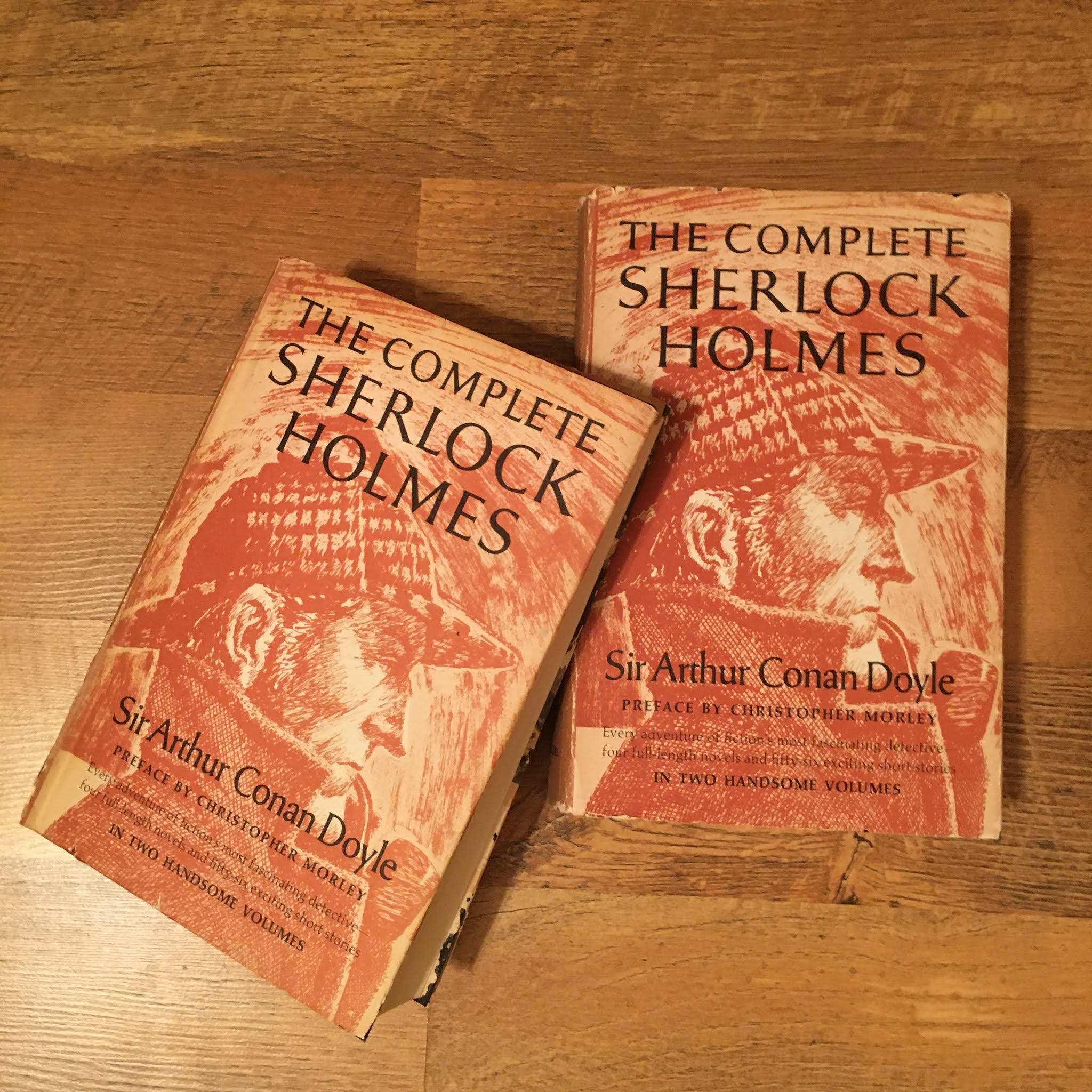
Well, at long last I have waded into the weird and wonderful world of Sherlock Holmes. Sherlock is one of those classic literary characters that I've always meant to read, but never got around to. We own The Complete Sherlock Holmes in "two handsome volumes" that Doubleday put out in the late 1920s. 
Because our Sherlock Holmes is all bound up in those two hefty editions, they sat on my shelf largely ignored for several years as classics I'd get around to someday. I didn't even know how many books Sir Arthur Conan Doyle had written about Sherlock or how they were compiled or anything until just this year. All I knew was that it was a lot and I didn't know where to begin. As it happens, right before our big move to North Carolina a few months ago, Cody and I snagged the BBC mini-series Sherlock on DVD from our Friends of the Library bookstore for a measly buck a season. After moving and getting settled in, we decided to start the show, and after watching the first episode, I decided it was time for my proper introduction to the OG Sherlock Holmes. 

So let me break down some of the quick facts for you: there were ultimately nine books Conan Doyle put out about the famous "consulting detective" Sherlock Holmes. Four novels, and fifty-six short stories which were originally published in magazines then later collected in five anthologies. The first (A Study in Scarlet) was published in 1887, and the final (The Case-Book of Sherlock Holmes) was published in 1927. Interestingly, Conan Doyle was ambivalent toward his popular creation. As the demand for Holmes stories grew, Conan Doyle actually wrote to his mother that he often thought of killing the character off and being done with him because "he takes my mind from better things." An idea which horrified his mother. In an attempt to scare off publishers, he raised his price level to what he thought was an unreasonable amount, but that didn't keep them away. He ended up becoming one of the best paid authors of his time. 

My "two handsome volumes" arrange the books of Sherlock Holmes chronologically according to the dates they were originally published individually and that's how I decided to tackle them. So in this post, I'll be talking about the first two novels: A Study in Scarlet and The Sign of Four. 

So this short novel was the world's first introduction to the now famous duo of Sherlock Holmes and Dr. Watson. Conan Doyle wrote it at the age of 27 in less than three weeks. 

The first part of the novel is written from the perspective of Dr. Watson as his diary. (Most of the subsequent stories about Holmes are written in this way—as Dr. Watson's reminiscences.) He recounts how he and Holmes came to meet and room together at 221B Baker Street in London, and then goes on to describe the first case he accompanied Holmes on involving a murdered man named Enoch Drebber. Shortly thereafter, Drebber's secretary Joseph Strangerson also turns up dead, and Holmes in his unorthodox and brilliant way figures the case out and apprehends the murderer. 

In the second part of the novel, we're abruptly taken back in time and across the ocean to the Salt Lake Valley in Utah in 1847 where a story unfolds about a man and little girl who are at the brink of death in the desert when they are rescued by a band of pioneer Mormons on the condition that they adopt the Mormon faith. 

Let me tell you, the transition between Part 1 and Part 2 of the novel was so abrupt and so unexpected that I spent a good bit of time wondering if this was actually two separate short stories and if we were ever going to figure out how Sherlock Holmes had solved the case in Part 1. As it turns out, Part 2 is the backstory of the two murdered men and their murderer, and it does all come together in the end. I was completely wrapped up in it, and just as impressed as Dr. Watson with Sherlock Holmes' uncanny ability to unravel the mystery. 

I have to add: Conan Doyle's unsparing and merciless depiction of Mormonism in this novel was a thing to behold. It took me by surprise, and I have to wonder, given Sherlock Holmes' universal popularity, if he has many Mormon enthusiasts and what their opinion of this first novel is. 

One other fun tidbit about A Study in Scarlet is that it was the first work of detective fiction to incorporate the magnifying glass as an investigative tool. 

The Sign of Four was Conan Doyle's second novel featuring Sherlock Holmes and his boon companion Dr. John Watson. It was commissioned in August 1889 by the American businessman Joseph Marshall Stoddart who was the managing editor of Lippincott's Monthly Magazine, and first published in the magazine in February 1890. 

This novel has a much more complex plot involving a stolen treasure, secret pacts among convicts and corrupt prison guards, poison darts, a one-legged man, and even a boat chase down the River Thames. It was quite a ride and I enjoyed every minute of it. 

We also get to meet Dr. Watson's future wife Mary Morstan in this novel, and we learn that Sherlock Holmes has a drug problem. It was a bit of a shock to open upon Holmes casually shooting up a solution of cocaine because he was bored by the recent lack of interesting cases with a disapproving Dr. Watson sitting by, annoyed. 

These first two novels were not particularly successful to start with, and it was the ensuing short stories that launched Sherlock's widespread popularity. I'm currently reading the Adventures of Sherlock Holmes and hope to also read the Memoirs of Sherlock Holmes to complete Volume 1 of The Complete Sherlock Holmes by the end of the year. I can't believe it's taken me this long in life to actually read some Sir Arthur Conan Doyle especially given my penchant for mystery stories as a kid. I thoroughly enjoyed his first two novels about Holmes and Watson. Conan Doyle's writing is sparse and to-the-point which makes for quick reading. His style reminds me a lot of Agatha Christie. It's easy to see how his influence has impacted the mystery writers that have followed him. So far the short stories are even more fun as they're easily read in one sitting, and it's no wonder they're so popular. I, for one, can now join the ranks of other Sherlock fans in recommending his strange cases to mystery lovers everywhere. 

Do you like a good mystery? Have you ever read any of Dr. John Watson's reminiscences about Sherlock Holmes? Do you prefer the novels or the short stories?