Showing posts with label 20th Century. Show all posts

Tuesday, April 28, 2026

Let's Bust a Recap : Carry On, Jeeves

2023 was definitely the year that contributed the most books to my current book list. There were seven books from my list that year that I never got around to reading, and Carry On, Jeeves was one of them. After my first introduction to Wodehouse in 2022, he got an automatic spot on my 2023 book list. The Inimitable Jeeves provided no end of laughs and considering that I dropped a pretty significant amount of good American money to add the Bertie and Jeeves collection to my personal library in 2020—ah, the year of massive online book shopping for me, how were you coping with the madness?—I wanted to make it a habit to read some Wodehouse each year. 
Alas, here we are, four years later before I finally picked up the second installment in my Wodehouse collection. And if we're being realistic, it'll probably be another couple of years before I pick him up again seeing as next year I'll be tackling My Life In Books project—have you voted yet?—and Wodehouse lived and died well before I was born. But not because I didn't enjoy Carry On, Jeeves. It was just as much of a riot as The Inimitable Jeeves, and I found myself laughing aloud again during every outrageous story. 

This collection of ten short stories which were popping up in the Saturday Evening Post were published together in London in 1925, and in New York in 1927. In this anthology, we get the origin story of how Jeeves came to be in Bertie's employ. Jeeves is enlisted, again, numerous times, to help Bertie's friends out of all manner of scrapes, particularly those having to do with maintaining good standing with wealthy aunts and uncles who bankroll their nephews' lives, and, of course, the frequent romantic entanglements they find themselves in. To give you an idea of how disastrously things turn out when Bertie tries to manage these conundrums without Jeeves' help, in this collection he inadvertently kidnaps a child, among other things. And this collection ends with a story from Jeeves' perspective in which he arranges for Bertie to give a talk at a girls' school after Bertie gets a wild hair to invite his aunt and three nieces to come and live with him. Jeeves is having none of that, and Jeeves always knows best. 

Another rip-roaring, laugh-out-loud good time. Douglas Adams said that "Wodehouse is the greatest comic writer ever" and I think I might agree with him. I have one more collection of short stories to read before I get to an actual novel in my Bertie and Jeeves library, and I'm very much looking forward to seeing how Wodehouse's novels compare to his short story collections. If you haven't read Wodehouse yet, move him up your TBR. 

What books or authors do you turn to for a good laugh?

Tuesday, March 10, 2026

Let's Bust a Recap : As I Lay Dying

A few weeks ago, I recapped my first Hemingway and now I've also tackled my first Faulkner, and you guys, I have to say: I haven't been particularly impressed with the Jazz Age bunch.  

Way back in 2018, I read The Great Gatsby for the first time and I remember thinking, "Really? This is the book we're all lauding as one of the best offerings of the 20th century? Really??" And then I found Hemingway painful. And now Faulkner who by the end of the novel I just kept thinking, "What a pretentious prig." 

(Why am I even comparing these three authors? They were contemporaries being born in 1896, 1897, and 1899, respectively, and they are all three often lauded as some of the greatest American writers of the 20th century. Faulkner and Hemingway both won the Nobel Prize in Literature, and Fitzgerald was nominated for it twice.)

But getting back to the pretentious prig. Faulkner himself bragged that he wrote As I Lay Dying "in six weeks, without changing a word" (not true) and that he "set out deliberately to write a tour-de-force." He claimed: "Before I ever put pen to paper and set down the first words, I knew what the last word would be...Before I began I said, I am going to write a book by which, at a pinch, I can stand or fall if I never touch ink again." Oh brother. If having a total disregard for punctuation and not finishing sentences is what it takes to make a great writer, then why do we even care about education? Honestly, why? 

But I digress. All my ranting aside, I liked Faulkner the best, and As I Lay Dying is one of the most unique pieces of literature I've ever read. (But hear me loud and clear: I am not equating uniqueness with inherent goodness. Different doesn't automatically mean better.) Stream-of-consciousness is not my favorite writing technique and Faulkner was one of the pioneers of it. 

As I Lay Dying—originally published in 1930, in case I haven't mentioned it—is basically the story of Addie Bundren's death and her rural family's subsequent quest to carry her body to its final resting place in her hometown of Jefferson, Mississippi, a request she made of them before she died. The book is written from multiple points of view—no less than fifteen!—and each "chapter" (if you can even call them chapters) are narrated by different people, including a couple by Addie herself after her demise. The main characters are the Bundrens, obviously: Addie's husband Anse, and her five children, Cash, Darl, Jewel, Dewey Dell, and Vardaman. Darl probably has the most of the 59 "chapters". It's a chaotic, dark, sometimes funny, a lot of times disturbing novel. Vardaman thinks his mom is a fish. Dewey Dell is stressing over an unwanted pregnancy and trying to obtain an abortion. Addie's body isn't embalmed so the stench the Bundrens take with them everywhere is a constant topic. Anse steals from his children. Cash's leg gets broken and they try to make a cast for it out of concrete. Darl starts a fire and gets taken away to an insane asylum. I cannot over-emphasize what a strange, tragic book this is. 

How do I wrap up a review like this? I will never read As I Lay Dying again. And I wouldn't really recommend it either. But I haven't stopped thinking about it. I'll definitely read more Faulkner. But it will be a few years before I pick him up again. 

How do you feel about stream-of-consciousness writing? Do you like Faulkner, Hemingway, or Fitzgerald? And which one do you like best?

Tuesday, February 24, 2026

Let's Bust a Recap : A Farewell to Arms

Well, I've got my first Hemingway under my belt and it was, as Rory Gilmore warned us way back in 2002, painful. And I don't mean that in a good way.

A Farewell to Arms was Hemingway's second novel and first bestseller. Published in 1929, it is considered by many to be the premier American war novel of World War I, and it cemented Hemingway's status as one of the great American writers of the 20th century. 

A first person narrative set during the Italian campaign of World War I, A Farewell to Arms tells the story of American Frederic Henry's time serving as a lieutenant in the ambulance corps of the Italian army and his passionate affair with an English nurse called Catherine Barkley. The novel is divided into five different "books" and, in my opinion, it was a complete slog up until almost the very end of the third book, but then the last hundred pages or so were completely unputdownable. But like in a I-can't-look-away-from-this-absolute-trainwreck kind of way. Much of Hemingway's work was autobiographical in nature, and he drew on his own experiences living as an expat and serving in the Italian campaigns of World War I to write A Farewell to Arms. The inspiration for Catherine Barkley was drawn from his first love, Agnes von Kurowsky, who ultimately spurned him in real life. And apparently ruined him forever. Her literary counterpart meets a pretty bleak end. 

I don't know, you guys. I can see the value in A Farewell to Arms for its true-to-life portrayal of the First World War and the Italian campaigns. There were glimmers of brilliance in there. I mean, who am I to poo-poo one of the "great American writers of the 20th century" and the 1954 winner of the Nobel Prize in Literature? But Hemingway's sparse style just wasn't my bag. While A Farewell to Arms wasn't sexually explicit, it felt crass to me, and Hemingway's dialogue is the thing of my nightmares. If more than two people were having a conversation, Heaven help you figure out who was saying what. His ending—which he famously rewrote some forty-odd times before landing on the one he chose—left me cold. Ultimately: not a book I'd read again and also not one I'd recommend. 

However, I have struck a bargain with my friend Jon—a literary exchange, if you will—wherein for every Hemingway I read, he will read a novel by Jane Austen. Jon has Mark Twain levels of hatred for Austen based on reading like one chapter of Persuasion over ten years ago. Given my recent discovery of my distaste for Hemingway's writing, this seems like a fair deal, and given that Jon has yet to even start one of my homegirl's most excellent works, I think I'm safe from Hemingway for a couple of years at least. 

What's your take on Ernest Hemingway or any of the "great" 20th century American writers in general?

Tuesday, January 20, 2026

Let's Bust a Recap : A Barrel of Laughs, A Vale of Tears

The first book I read this year was A Barrel of Laughs, A Vale of Tears by Jules Feiffer, and yes it has jumped the line of other recaps I'm still planning to write someday for the sole reason that it is my sister's all-time favorite book, and it is one of my biggest missions in life to never disappoint her in any way. (We don't mind a run-on sentence around here, sorry if you're new.)

A Barrel of Laughs, A Vale of Tears was published in 1995 and it's basically the story of Roger, a prince who makes everyone laugh all the time. But not in a good way; more in like a we-can't-be-around-him-for-too-long-or-we-will-literally-die-laughing kind of way. In order to sober him up and make him into a worthy monarch, his father, King Whatchamacallit, recruits the help of J. Wellington Wizard to send Roger on a quest to accomplish the purpose. 

The book starts out very silly. I was mildly amused and there were certain things that put me in mind of my sister's sense of humor. (There was a line about ketchup in particular that made me think, "Did this book shape Sarah's entire personality?") Jules Feiffer's style reminded me a bit of Norton Juster's in The Phantom Tollbooth, just not as clever. But then I realized Feiffer illustrated The Phantom Tollbooth so maybe that's what actually triggered the comparison? Either way, the narrator is an absolute hoot, breaking the fourth wall constantly to explain the story and certain characters to his readers. After a couple chapters of silliness though, I was starting to wonder if we would really get anywhere or if I would even ultimately enjoy the book on the whole. I thought maybe the reason Sarah likes A Barrel of Laughs so much is more for the nostalgia since she's loved it since she was a kid and oh no, what if I have to lie to her about what I think?? because obviously disappointing her to tell her I thought it was ridiculous is not an option (see above). 

But I truly and honestly had nothing to worry about. Sarah's taste is not to be questioned. She is, after all, the one who finally convinced me to read Harry Potter. As Roger's quest went on and he learned to genuinely care for others and their well-being more than just laughing his way through life, I was impressed with the way Feiffer snuck profound truths about life into his book. Because sometimes, people you thought were your friends really do turn against you for no reason and make your life harder. And sometimes, our own deep-seated insecurities and anxieties really can be our worst enemies. We really do need help from others sometimes to tell us the truth and pull us out of the funk of our own making we've descended into. Some days we're soaring, and some days we're barely hanging on. Some days we're rescuing others, and some days we need the rescue. And most importantly, life rarely goes according to plan. It is our response to the life we actually find ourselves in—not the life itself—that will determine our happiness. 

What I'm saying is: A Barrel of Laughs, A Vale of Tears is a fantastic book. And now I need to buy my own copy because Sarah lent me hers to read. You should definitely read this book too. Come for the laughs, stay for the reminder that life isn't all bad and it's how you choose to look at it that can make the difference. 

Thursday, December 18, 2025

Let's Bust a Recap : Animal Farm

On Monday, I shared my recap on Frankenstein, literature's definitive horror story. Today, I'm reaching back in the archives of my mind to finally recap Animal Farm, the other book I put on my 2025 book list specifically because of a new movie adaptation. Animal Farm turned 80 this year and I read it in June. As far as I'm concerned, it's far more horrific than Frankenstein, and after finally reading this slim classic, I have no desire to watch Andy Serkis' new adaptation, the release of which has been pushed to next May anyway.

If you're unfamiliar with George Orwell's Fairy Story about the anthropomorphised animals on Manor Farm, it's basically just Orwell crapping all over Stalin and the Soviet Union. 

"It's important political satire!" "It's an allegory!" "It's dystopian literature at its finest!"

It's about as subtle as a sledgehammer, is what it is, and I felt sick the entire time I was reading it. By the time the glue truck turned up to take Boxer away, I wanted to chuck the whole thing in a fire and watch it burn. 

I'm not one to go looking for the symbolism or deeper meaning in books that just isn't there. But Animal Farm is unapologetically political and if you have two brain cells to rub together, you can't escape what Orwell is writing about. Old Major is basically an amalgamation of Karl Marx and Vladimir Lenin. Napoleon (the most despicable character in the whole of the novella) is Joseph Stalin. Snowball is Leon Trotsky. And Squealer represents the Soviet nomenklatura and journalists, justifying every little thing Stalin says and does. Then you have the other animals who are worked to death under Napoleon's regime and the poor puppies who are stolen at birth and trained to be his terrifying security force. Orwell drives his point home hard at the end of the novella when the animals look in the window at the pigs' dinner party with the neighboring human farmers and they can no longer distinguish between the pigs and the men. 

Animal Farm is a searing portrait of how a revolution for equality is corrupted by power, leading to an even worse tyranny. The silencing of dissent, the manipulation, the utter betrayal of ideals all vividly portrayed by Orwell in his Fairy Story are important topics and things we absolutely must be attuned to recognize. The whole those who forget history are doomed to repeat it. But reading Animal Farm is not a fun time, and I'd caution you against picking it up unless you're prepared to grapple with the boundless depths of human depravity—depicted by a bunch of literal pigs. It's rough sailing but I do think it's worth reading if you can stomach it. 

Wednesday, November 26, 2025

Let's Bust a Recap : Ramona Quimby

Here's the thing about Beverly Cleary: of all the books I've ever read in my entire life, Beverly Cleary can write a book that's supposed to be from a child's perspective, like it's actually from a real child's perspective. She has the uncanny ability to tap into a child's psyche so well, and it makes actual kids want to read her books. I love children's literature. Truly, it may be my very favorite genre. Children's books make it into my reading rotation every single year. And Beverly Cleary is the absolute queen of writing books about kids, for kids.  
Back in 2021, I started reading Beezus and Ramona with my nieces while they were visiting in the summer. It was just a quick trip and I wasn't quite able to finish the book with them, but of course that didn't stop me from finishing it by myself shortly after they left. Last year, during a week-long slumber party at Uncle Cody and Auntie Hannah's house, I picked up the next Ramona book to read to my niece and nephews. For the purposes of this post, I'll call them Thing One, Thing Two, and Thing Three. During that week, we flew through Ramona the Pest and Ramona the Brave. The kids immediately fell in love with Ramona and when Thing One realized there was actually a book before Ramona the Pest that I hadn't read to them, she checked it out of her school library to read for herself. If that's not a testament to Beverly Cleary's genuine connection with children, I don't know what is. For the rest of 2024, if I showed up at a family gathering without our current Ramona book, I was ordered back home to get it so total anarchy didn't ensue. (It's a good thing we all live in the same neighborhood!) We actually finished Ramona's World, the final book in the Ramona series, on Christmas day. 

There are eight books about Ramona Quimby, from Beezus and Ramona, published in 1955, all the way to Ramona's World, published in 1999. The very first book is from the perspective of Ramona's older sister Beezus who gets very annoyed with Ramona's antics but learns she can always love her little sister—even if she doesn't always like her. The following seven books are all from Ramona's perspective as she goes to kindergarten with her neighbor Howie in Ramona the Pest, up until her fourth grade year in Ramona's World. Ramona finds herself facing all sorts of challenges like bullies at school, teachers she loves and teachers she doesn't like, her dad losing his job, her family expecting a new baby, a family pet dying, making a best friend, and a beloved aunt getting engaged and married. While all these books were written and published before the twenty-first century, the struggles and triumphs, growing up and all the big feelings that go with it, are timeless, and Cleary's books have given children a protagonist they can honestly see themselves in for generations now. Thing One, Thing Two, and Thing Three were all absolutely riveted by Ramona Quimby, and the Ramona books are the only books I've ever read to them where I had the undivided attention of all three whenever I was reading. After we finished reading the entire series, I asked them each to tell me their favorite parts of the books and here's what they said:

Thing One liked when Ramona put the hard-boiled egg on her head (from Ramona Quimby, Age 8) and when she made the tiara out of burrs (from Ramona and Her Father). 

Thing Two liked it when Ramona made an engagement ring out of a worm in Ramona the Pest. (I love that Thing Two's favorite part was one that wasn't depicted in the phenomenal film adaptation starring Joey King as Ramona Quimby. Which we watched twice.)

And Thing Three loved drawing the longest picture (from Ramona and Her Father...and also from our basement because we obviously had to draw our own longest picture), and his other favorite part was when Ramona fell through the ceiling in Ramona's World. 

If my glowing review hasn't already tipped you off to my feelings about it, let me say this loud and clear: the Ramona Quimby books are an absolute treasure and I highly recommend them—specifically to be read aloud to children or for children to read for themselves. As I alluded to above, the movie is also a delight and one of my all-time favorites. Scenes from every single book are lovingly incorporated into it and I cannot get through it without laughing and sobbing—every. single. time. Don't miss out on Ramona Quimby. 

What is your favorite children's book? Seriously, please tell me. I'm always looking for good ones to ward off the cynicism that seems unavoidable in this world. 

Monday, November 24, 2025

Let's Bust a Recap : Seabiscuit

Y'all. I would read the phone book if Laura Hillenbrand wrote it. I've read Unbroken twice now; I've read her piece in The New Yorker about the sudden onset of a then unknown illness which she has suffered from ever since; and now I've finally read Seabiscuit. I think I waited so long to read it simply because it's her only other book and who knows if she'll ever write another one. Consider this my official plea to have all her freelance writing collected and offered in book format. At least all the stuff she wrote for Equus magazine. Pretty please with cherries on top?

Incidentally, I have discovered that my toxic trait (well, one of them anyway) is reading one-star reviews for objectively exceptional books. (Or maybe just my favorite books. Semantics.) One Goodreads user in their one-star review of Seabisuit said—and I quote: "I want to read about people, not horses."

FOR A BOOK ENTITLED SEABISCUIT.

Oh for the love of Lori Loughlin. 

And while Seabiscuit is certainly a thorough biography of one of the most beloved racehorses of all time, it is also a biography of three men: Charles Howard, Seabiscuit's owner; Red Pollard, Seabiscuit's best jockey; and Tom Smith, the horse trainer to end all horse trainers. 

Laura Hillenbrand first covered the subject of her 2001 biography Seabiscuit in an essay that was published in American Heritage magazine. After getting so much positive feedback, she proceeded to write a full-length book which went on to become a bestselling, award-winning masterpiece and the source material for the 2003 film starring Tobey Maguire as Red Pollard which went on to be nominated for seven Academy Awards. (The film ultimately didn't win in any of the seven categories but what can you do when you're up against the third installment of the Lord of the Rings trilogy which beat it out in six of the seven categories??)

Much like her later biography Unbroken, Seabiscuit absolutely captivated me and I had a hard time putting it down. For probably a solid month while reading it and afterward, I talked Cody's ear off about every single detail and made him listen to excerpts that I'd read to him aloud. And don't get me started on those one-star reviews again. My poor husband was audience to a passionate tirade about all the idiots who wouldn't know good writing if it bit them in the armpit

Seabiscuit is a true underdog story and I think therein lies the appeal. Of Charles Howard, the bicycle-repairman-turned-millionaire that no one took seriously as a horse owner. Until Seabiscuit started winning. Of Tom Smith, the unconventional horse trainer that everyone ridiculed and dismissed, mocking his unorthodox methods. Until Seabiscuit started winning. And of Red Pollard, the most accident-prone jockey you ever heard of that everyone actually gave up for dead. Until he rose from the grave and saddled a horse people thought would never race again and won

But the undisputed star of Hillenbrand's sensational book is Seabiscuit himself. This awkward little horse with his Eggbeater gait won the hearts of the entire country back in the 1930s and he completely won mine as well. I was on the edge of my seat for every single race Hillenbrand covered and what I wouldn't give to have seen him run in person. I cried when I came to the end of the book. Charles Howard was known to silver Seabiscuit's race-worn horseshoes, mount them on ashtrays, and give them as gifts. I may or may not have done an internet search after finishing the book to see if any are still in existence and what it might cost to obtain one. (Spoiler: they're rare and completely out of my budget.)

And you guys. What jockeys would do to make weight will forever be seared into my memory after reading Seabiscuit. I somewhat expected the fasting, the sweatboxes, the laxative use. But intentionally ingesting tapeworm eggs?? Horrifying. The lengths these men would go to for their profession was life-threatening and absolutely appalling, but fascinating nonetheless.

On a final note, after finishing the book I watched—for the first time—both the 2003 film adaptation of Seabiscuit and also The Story of Seabiscuit starring Shirley Temple that came out in 1949. Neither one can touch Laura Hillenbrand's phenomenal writing and I'm sad to report that the Shirley Temple film just isn't any good at all. Whoever decided that my beloved Shirley Temple should attempt an Irish accent should be criminally tried. 

While I may not recommend Seabiscuit as widely as I recommend Unbroken, it is an absolutely brilliant piece of storytelling and a gripping bit of history. If you have any interest in horses at all, this is a book you cannot miss. 

Who's your favorite non-fiction writer?

Thursday, October 2, 2025

Let's Bust a Recap : Pollyanna

Well, despite the fact that I have no less than nine recaps sitting in drafts—some still from last year—I've spent this week blogging about my three most recently finished books. And none from my 2025 book list, to boot! C'est la vie. 

I've loved the 1960 film adaptation of Pollyanna since I was a little kid, and while I thought it would probably be lovely to read the 1913 novel by Eleanor H. Porter that inspired this classic, I've never come across a copy or made it a point to seek one out. 

But when my thirteen year old niece got her assigned reading list for school this year and Pollyanna was on it, I ordered a copy immediately and told her I'd happily read it with her.

And what a joy.

If you're unfamiliar with Pollyanna, that extraordinary child, well, don't feel bad because as it turns out, none of my nieces have yet seen the film. I know. It is a situation I will rectify as soon as possible. Pollyanna is the story of an eleven year old orphan sent to live with her dutiful Aunt Polly Harrington. After getting a pair of crutches instead of the hoped-for doll in a missionary barrel, Pollyanna's father makes a game out of finding something to be glad for in every situation. After Pollyanna's father dies and she's sent to live with Aunt Polly, she immediately begins a personal campaign to convert the inhabitants of Beldingsville to her glad way of life—except Aunt Polly who won't tolerate any mention of Pollyanna's father. And so our titular character became a byword for every eternal optimist. (Although calling someone a "Pollyanna" seems to be fading out of the vernacular to my everlasting chagrin.)

For the first eleven or twelve chapters, my beloved movie adaptation starring the perfectly cast Hayley Mills as sunshine-y—but not saccharine—Pollyanna seemed to follow the book to the letter, and I truly wondered if I would get much out of the reading experience. But as is almost unfailingly the case, the book had so much more to offer. One of the biggest changes was making young John Pendleton from Porter's beloved book into a much older man in the film adaptation. In the book, it's more of a mystery who Aunt Polly's scorned lover is and Mr. Pendleton is a strong contender. In my opinion, Porter's original story makes the adoption of Jimmy Bean so much more meaningful. The other big change is the nature of Pollyanna's horrible accident and subsequent care she received from her aunt and the town. The book proves so much better, but I'll always love Walt Disney for bringing this one to life on the screen. 

In case you couldn't already tell, I absolutely loved Pollyanna. It had all the hallmarks of an All-Time Favorite: it made me laugh and cry, I couldn't put it down but was sad when it ended, and it's a book I'm sure I'll reach for again. Yes, read the book; and yes, watch Hayley Mills bring Pollyanna to life. 

So there you go: a short and sweet review for this short and sweet book. What things make you glad?  

Thursday, September 18, 2025

Let's Bust a Recap : Desiring God

In 2003, the third edition of John Piper's seminal work, Desiring God, was published. It was big that year with one of the circles in my church's youth group so, naturally, being the bookworm that I am, I expressed an interest in reading it and my Dad got me a copy for Christmas. Well, I tried to start it a couple different times but never got much farther than the introduction. It's just not very easy to read. And it took me a while to get into it this time around as well. But your girl's not a quitter so I muscled my way through it and now I have a lot of thoughts about it that feel very disjointed so this recap is turning out to be a real struggle. 

Let me begin by saying: overall, I agree with pretty much everything Piper says in this book. It's Biblically sound and doctrinally I align with him.

But let me follow that up immediately with: I fundamentally disagree with the term "Christian hedonist" and as this entire 400 page book is a defense of this label, it was tough sledding at times. Piper himself is quick to admit that his pet phrase is shocking and that many respected theologians he is friends with don't appreciate it either. And he gives his reader permission to dismiss the vocabulary, if not the actual concept. So I have. You will never catch me calling myself a "Christian hedonist" and here's why. Words have meaning. And when you say certain words to people who don't have the time to read a whole book about why that word should mean something different than what they think, you're liable to give them the completely wrong idea about what you're saying. 

Piper quotes Saint Augustine early in the book:
If I were to ask you why you have believed in Christ, why you have become Christians, every man will answer truly, "For the sake of happiness."
This sums up Piper's thesis quite nicely and for the entirety of Desiring God, Piper quotes other thinkers and writers to great effect. So much so that I almost appreciated his quotations more than his original writing. And I'm not mad at that. The idea that as a Christian I should strive to find and do find all my happiness in God and that I cannot be truly happy apart from God is one I wholeheartedly agree with. He works out this concept for the reader in nine different areas of the Christian life including conversion, prayer, money, marriage, suffering, etc. And like I said at the beginning, I agree with his conclusions. The thing that makes this book so difficult to read is his writing. I would start a chapter and within the first quarter of the chapter, I would grasp exactly what he was trying to convey. And then the chapter went on unnecessarily for another three quarters. He would muddy up his clearly stated premise, and then at the end of each chapter offer another clear summary of his belief. Ultimately, I think this book could have accomplished his mission with about half the word count. 

This came as a bit of a curveball for me as the only other Piper I've read (This Momentary Marriage which I read in 2020) I praised as being so clear and straightforward (if a bit repetitive). But given that Desiring God was the third book Piper ever wrote and it came over twenty years—and over forty books!—before This Momentary Marriage, perhaps that makes sense. 

The greatest value for me in reading Desiring God was the reminder, the argument that being a Christian is supposed to be a joyful, happy thing. Piper rightly states in his book that so often in Christendom, the command to deny ourselves is misinterpreted to mean that if we're coming to Christ in a desire for our happiness, our motives are selfish and therefore, invalid. It can feel exhausting at times to be obedient to God and so we like to make that exhaustion in and of itself a virtue. But how better can we glorify God—our chief aim in life—than by being exuberantly, abundantly happy in Him? 

Would I recommend Desiring God? Not to everyone. If you're having a difficult time reconciling how to come to God seeking your own happiness while simultaneously giving Him all the glory, this is your book. If you're feeling cynical and hopelessly weighted down in your Christian walk, give this book a try. I'm definitely glad I read it, though it's not one I would necessarily pick up again. I am looking forward to reading The Pleasures of God which is the next book in Piper's unofficial Desiring God trilogy which concludes with his book Future Grace. The Pleasures of God is my husband's favorite book by Piper and he recommended Desiring God for my book list this year mainly so I could get to The Pleasures of God next.  

The TL;DR version: good, not great; glad I read it, probably wouldn't read again.

What do you think of when you hear the term "Christian hedonist"?

Friday, September 12, 2025

Let's Bust a Recap : The Story of the Trapp Family Singers

I have been meaning to read the true story of Fräulein Maria and the von Trapp family since at least college when I went to Austria on a short study tour. The Sound of Music has been one of my favorite movies (and, I would argue, one of the greatest movies of all time) since I was a small child. I can sing every song from the iconic soundtrack—and often do—a power achieved not only from watching the film countless times, but from hearing my mother play the songs on the piano throughout my childhood and learning to play many of them myself. I always knew The Sound of Music was based on a true story, but I didn't realize that Maria herself had written it—years before the film came to be—until much later in my life. I've had my eyes peeled for a copy for years, but never came across one in the myriad bookstores I've visited. After rewatching the film for the gazillionth time earlier this year, I decided enough was enough: it was time to order a copy and finally read it. So in the middle of the night, while my husband was sound asleep (he didn't even make it through the first quarter of the movie), I opened my laptop, found a used copy on AbeBooks, and purchased it for $6.16. Before the book even arrived in my mailbox, I discovered that not only is the movie turning sixty this year, it's being re-released in theaters nationwide for the anniversary, and I'd have the opportunity to see it on the big screen about midway through September. So when the book did arrive, instead of reading it right away, I stuck it on my trusty book cart with the rest of my 2025 TBR and determined to read it right before going to watch the film at my local cinema. 

And come last week, on September 1st, I sure enough picked up The Story of the Trapp Family Singers by Maria Augusta Trapp and started to read it. 

And it is my favorite book of the year (so far). I laughed, I cried: it was the best of times. 

Originally published in 1949, The Story of the Trapp Family Singers starts where The Sound of Music starts, with mischievous Maria living as a novitiate at Nonnberg. The book is divided into two parts with the first part covering what we see in the film, and the second, much larger part covering the family's story after escaping from Nazi-occupied Austria. While I think The Sound of Music actually does a lovely job with Maria's story, after reading the book I've realized the film gives just a teeny tiny glimpse of a teeny tiny slice of the von Trapp family's life. There was so much I didn't know about the Trapp Family Singers. Like the fact that before Germany annexed Austria, the Trapp family traveled all over Europe singing for monarchs and even the pope. And that to escape Austria, they actually signed a contract for a concert tour in America and moved to the United States where they eventually became citizens and started their own Trapp Family Music Camp. Not to mention the relief work they did after the conclusion of the war to help Austria recover. The von Trapp Family Lodge and Resort is a travel destination in Vermont to this day...and has been added to my personal bucket list of places to go as soon as possible. 

I wasn't exactly sure what to expect when I picked up this book, but I loved Maria's simple, straightforward writing style, her no-nonsense, honest approach to telling her story, and especially how her deep faith was woven throughout every inch of this von Trapp family history. It was absolutely beautiful to read. And not only that: Maria was funny. Her story of being in the hospital after a surgery to have kidney stones removed and convincing her gullible nurse that the pet turtle Georg brought to keep her company is an animal that feeds on newborn babies' toes had me howling with laughter. I will add that Maria, like all of us, was very much a product of her own time and place in history, and at times it was jarring to see terms pop up in her writing for people of color, including black, Asian, and Native American people, that are no longer acceptable today. There was obviously no malice behind these monickers which made them seem even more out of place in this otherwise charming book. 

I can't recommend The Story of the Trapp Family Singers highly enough. Before I was even halfway done with the book, I texted my mother and told her she needs to read it immediately and I talked to my sister and told her she needs to read it, too. My mother and I, along with my sister-in-law and one of her friends, will be going to see the film based on this amazing story tomorrow night, and I'm excited to watch it once again, this time with a much fuller understanding of what this incredible family went through. 

What's the last book that absolutely delighted you? And do you plan to go see The Sound of Music this weekend on the big screen?

Monday, June 16, 2025

Let's Bust a Recap : A Separate Peace

Okay, here's the thing: A Separate Peace was the first book I finished this year, and to be completely 100 with you, it's what threw this whole blog into a tailspin. How do you recap something so good? I've faced this problem before, but after ten years of blogging, getting the flu at the end of last year, and all the real life in between: I just wasn't up for the challenge. 

And I'm still not up for it. But we're doing it anyway because this book deserves its corner on the blog. 

On its face, John Knowles' 1959 debut novel is a young man's coming-of-age story set against the backdrop of World War II at a New England prep school. At the beginning of this novel, Gene Forrester returns to The Devon School fifteen years after leaving it and reflects on his time there from the summer of 1942 to the summer of 1943. At that time of his life, he's sixteen and living at Devon with his best friend and roommate Finny. Quiet, intellectual Gene and carefree, athletic Finny are about as unlike as two boys can be, but they are the closest of friends and in the summer of '42 they form a secret society with their friends, Finny seemingly doing his best to shut out the war and cling to their childhood for a few more precious weeks while the rest of the boys are trying to figure out how to grow up and get to the war. Gene in particular is going through a difficult process of self-discovery in regards to his friendship with Finny, moving from an envy and one-sided rivalry with his chum to the realization of Finny's quality and wanting to emulate him. 

It's heartbreaking. Like, I think my heart actually broke while I was reading this book. The National Review called it "a masterpiece", and truly it is nothing short of one. Much of this book is autobiographical in nature, and I think that's what makes it so successful. John Knowles went to a New Hampshire prep school during WWII and served in the US Army Air Forces at the very end of the war after finishing school. None of his other novels garnered the same success as A Separate Peace or continued to live in the public consciousness like this one did. It's still assigned reading in some school curriculums. 

I actually drew this title out of my TBR Jar last year and read about half of it before setting it aside to read some library books before they were due. This was a book that I could read slowly because every word stayed with me no matter how much time passed between the times I opened it. I put A Separate Peace in the same class with The Adventures of Huckleberry Finn or The Optimist's Daughter: I want to convey how good it is, but I'm at a loss for words. I want to recommend it to you, but maybe not if you won't appreciate it. It's just brilliant. I'll be sharing an excerpt that broke me on Wednesday. Maybe that will give you a sense. 

How do you feel about coming-of-age stories?

Friday, December 13, 2024

Let's Bust a Recap : The Best Christmas Pageant Ever

The Best Christmas Pageant Ever has been on my radar for years. I missed out on it as a kid, and I've had my eye out for it for quite some time. But when the trailer for a feature film adaptation dropped earlier this year, I went ahead and ordered myself a copy from AbeBooks. I read it the day before my husband took me to see the movie in our cute, one-screen, downtown theater.

And I loved it.

And I went back and watched the movie a second time with my mom, sister-in-law, and mother-in-law. 

The Best Christmas Pageant Ever—book and movie—will, without a doubt, become a part of all my future Christmas traditions. 

This beloved children's novel was written by Barbara Robinson and published in 1972. It features the six awful Herdman siblings who, after showing up to Sunday school for the free snacks, decide to star in the annual Christmas pageant by volunteering for the six main roles: Mary, Joseph, the angel, and the three wise men. None of the other kids dare stand up to them, and the whole hilarious tale is narrated in the first person by Beth Bradley whose mom is directing the pageant for the first time after Mrs. Armstrong—the usual director—falls and breaks her leg. As word spreads that the Herdmans have hijacked the pageant, the whole town expects disaster, but, in a beautiful twist, the Herdmans end up teaching the town the true meaning of Christmas. 

I know I already said I loved it, but you guys: I. Loved. It. This little novel delighted me from beginning to end, and weighing in at a slim 80 pages—including full page illustrations—you can easily read it in one sitting. I genuinely laughed out loud the whole way through until getting to the pageant itself at which point tears were streaming down my face. What an absolute treasure of a book.

And the movie! So much care was taken with this 2024 adaptation. The majority of the screenplay was lifted straight from the book. In my year of reading/watching book-to-movie adaptations: The Best Christmas Pageant Ever was another smashing success. I think the book comes off a little funnier and the movie a bit more sentimental but both are absolutely wonderful, and, as I said above, I'll be reading and watching in all my Christmases to come. What a joy! I cannot possibly recommend this little gem enthusiastically enough. Get your hands on a copy and read it immediately. 

Do you have any books or movies you like to watch every year at Christmastime? What are your favorite Christmas traditions?

Tuesday, December 10, 2024

Let's Bust a Recap : Lonesome Dove

Hi! Believe it or not, I'm still here, and how are we all doing? Can we believe it's only 15 days till Christmas? You hanging in there? With Thanksgiving being so late this year it feels even crazier than usual. Or is that just me? The day after Thanksgiving, I sat down with my laptop and put together drafts for all the books sitting in my book cart waiting to be recapped. I scheduled them for every Monday/Wednesday/Friday in December. 

And then I completely missed the first week of December. And yesterday for that matter. 

But we keep trying and today we're going back to the book that's been sitting in that cart the longest: Lonesome Dove. 

Larry McMurtry's Pulitzer Prize-winning novel published in 1985 is widely considered to be the greatest cowboy book of all time. And I think it's the first western I've ever actually read, at least as an adult. I grew up on John Wayne movies—shoot-em-ups, as my dad fondly calls them—playing cowboys and Indians with my brothers, and having Lonesome Dove as my introduction to the genre seems like a disservice to any other western that might come after. It is epic and I get why everyone thinks it's the best. 

But where do I begin? First off, I have a little bone to pick with McMurtry. In this newer edition of the book, there's a 2010 preface in which Larry Jeff McMurtry spoils his own book. And I will never forgive him for that. What kind of an author are we dealing with here? Unbelievable. I don't want to speak ill of the dead, but I don't think I could have hung with Larry. He was one of those uppity types that basically got upset when his book got popular because people obviously must not have understood it. Give me a break, sir.

Now that I've got that off my chest: on to the actual book. In the small Texas border town of Lonesome Dove in the late 1870s, we're introduced to two famous retired Texas Rangers: Woodrow F. Call and Augustus McCrae. They're running the Hat Creek Cattle Company and Livery Emporium with a colorful outfit of men and young Newt Dobbs whose late mother was a sweet prostitute named Maggie. When Jake Spoon, one of Gus and Call's old Ranger buddies, drops into Lonesome Dove on the run from the law, waxing poetic about the beauty of the Montana Territory, Call gets it in his head to drive a herd of cattle up and settle the last great frontier. Through a series of events, Jake Spoon and Lorena Wood, Lonesome Dove's lone beautiful prostitute, end up on the cattle drive too and we're off to the races. 

Meanwhile, over in Fort Smith, Arkansas, July Johnson is the sheriff tasked with bringing Jake Spoon to justice, so while the Hat Creek outfit is heading north, July is busy tracking Jake Spoon west across the plains. But July's jaded wife Elmira sees an opportunity in July's departure to make her own getaway from their marriage and hops on a riverboat with a bunch of rough and tumble buffalo hunters, so July's deputy sheriff Roscoe Brown heads out after July to make him aware of his wife's betrayal.

As you can see, there are a lot of moving parts and threads to follow in this 858-page doorstop of a western. Through dangerous river crossings, dust-ups with hostiles, a terrifying abduction, young love, old love, and lots of death, we hang with these characters through the most harrowing experiences imaginable. Lonesome Dove truly is an epic and I echo USA Today's sentiment when I say, "If you read only one western novel in your life, read Lonesome Dove."

My husband and I read this aloud together from March to July and we've been meaning to watch the critically acclaimed 1989 miniseries ever since, which is part of the reason I waited so long to recap this. (Don't get your hopes up: we still haven't gotten around to watching it.) The day we sat down to start this novel, we ended up reading the first 14 chapters which is over 160 pages. Cody and I both loved the characters McMurtry brought to life on the page. But as my husband succinctly put it: Lonesome Dove started strong but didn't end strong. As is the case with a lot of epic works of literature (I'm lookin' at you Anna Karenina, Count of Monte Cristo), after you've spent so much time in the lives of these characters, the ending comes abruptly. And this isn't a spoiler but I will just warn you: no matter what character you set your love on in Lonesome Dove, don't expect a happy ending. The final chapters are bleak. 

For all that, we loved Lonesome Dove and I think it's a novel worth reading. We're still looking forward to settling in with the miniseries sometime this winter to watch Robert Duvall and Tommy Lee Jones bring Gus and Call to life on the screen. Ideally, we'd like to watch it with the rest of my family. We all decided to read it together this year. My brother Reagan flew through it and my sister Sarah is almost done. I'm not sure about everyone else, but come Christmas Day you may catch us all sprawled out on couches with Mom's apple pie watching young Newt try to figure out life in the Old West. 

Tuesday, October 29, 2024

Let's Bust a Recap : Dandelion Wine

Is Ray Bradbury my favorite author now? That is the question I found myself asking as Dandelion Wine immediately became one of my All-Time Favorite Books while reading it this summer. A few years ago, I read my first Bradbury—Something Wicked This Way Comes—and while I wouldn't necessarily say it's an All-Time Favorite Book, it did contain one of my All-Time Favorite Literary Scenes. When Dandelion Wine fell out of the TBR Jar right at the beginning of summer, I once again found myself immersed in the perfect book at the perfect time, and I savored Ray Bradbury's 1957 novel slowly over July and August. 

I say "novel" but Dandelion Wine could also be accurately described as a series of short stories loosely connected by their summer setting and the Spaulding family. The book centers around Douglas Spaulding, age 12, in the summer of 1928 in his small hometown of Green Town, Illinois, and his exploration of and attempt to capture his own coming of age in his journal with the help of his younger brother Tom. Just as Douglas' grandfather's homemade dandelion wine in the book serves as a metaphor for all the distilled joys of summer, so Dandelion Wine the novel itself is nostalgia distilled. I fell in love with it from the very first words, and sipped it slowly all summer long. When I finished reading it, I immediately ordered The Martian Chronicles.

I don't have much else to say. After reading Something Wicked This Way Comes and now Dandelion Wine, I feel confident in saying that Bradbury is a master of evoking a sense of place and memory in his writing, and he somehow manages to spill the human heart onto the page. Even though I've never been a twelve year old boy, or lived any summers before 1987, or seen a small Illinois town; Dandelion Wine somehow took me straight back to my own childhood summers, running wild over my small Central Florida town with my brothers and all my best friends, and living as hard as I could before school started again in the fall. Dandelion Wine should be read outside—preferably on a front porch—and stretched to last as long as possible, just like we wanted to stretch those childhood summers out forever. 

Despite Dandelion Wine winning a spot on my All-Time Favorites list, I wouldn't recommend it to just anyone. That often is the case with my favorite books. I feel more protective of them, and don't want someone who won't appreciate it reading it. So if you pick this one up, don't come to me to do anything other than praise its beauty because you will not find a willing audience in me. Dandelion Wine is a treasure. 

What are some of your All-Time Favorite Books?

Also, I just have to include this fun fact: our main character in Dandelion Wine was Ray Bradbury's childhood version of himself and he named him after himself and his father, "Douglas" being Bradbury's middle name, and "Spaulding" being his dad's middle name. Just another reason to love this little gem of a novel. 

Tuesday, October 22, 2024

Let's Bust a Recap : The Haunting of Hill House

This week's theme is *sPooKy sEasOn* and today we're talking about the definitive haunted house story. Shirley Jackson's 1959 Gothic horror classic The Haunting of Hill House is widely considered to be one of the best ghost stories ever written. Famous authors including Stephen King and Neil Gaiman have talked about how this book scared the pants off them and I'll be honest with you at the outset: I don't get it. At best, The Haunting of Hill House was mildly unsettling. 

But that's just one reader's opinion. 

Admittedly, I generally stay away from "horror" but I love a good Gothic classic, and for its place in that canon, I've had Shirley Jackson's famous haunted house story sitting on my shelf for a few years now. My husband expressed interest in reading it before watching the popular Netflix adaptation and so we eventually decided to read it aloud together. Maybe that took away from the creepiness of it? We still haven't watched the series which I understand is more inspired by the novel than an actual adaptation of the material. 

In The Haunting of Hill House, we're introduced to socially awkward Eleanor Vance who is on her way to Hill House to participate in a study being put on by one Dr. John Montague to investigate the claims of supernatural happenings at Hill House. The good doctor is hoping to find actual scientific evidence of the existence of the supernatural, and he has invited a list of people known to have had paranormal experiences to come and live with him there. Only Eleanor and one other young woman named Theodora have accepted this invitation, and they go to join Dr. Montague and the young heir to the estate, Luke Sanderson, to stay in Hill House for a few weeks. 

And weird stuff happens. But is it actually happening or is Eleanor imagining it? Or are the other inmates of the house tricking Eleanor? Maybe even drugging her? As Dr. Montague slowly unfolds to his guests the dark history of their abode, we the readers begin to wonder if Eleanor will meet a grisly fate similar to the predecessors of Hill House. And why won't the Dudleys—the husband and wife caretaker and housekeeper duo—stay anywhere near the house at night?

As Cody and I read through this short novel, it was interesting to speculate about what was going on in the spooky mansion. Many of the strange occurrences are described by Jackson only vaguely which I guess adds to the creep factor? My favorite part of the book was when Dr. Montague's ridiculous wife shows up with her companion, Arthur Parker, the headmaster of a boys' school, to take charge of the investigation and they basically do a bunch of séances to commune with the spirits at Hill House. They were a riot. I also enjoyed any time Mrs. Dudley graced the page. Unlike the sinister housekeeper Mrs. Danvers in Rebecca who sent shivers up and down my spine, I found Hill House's Mrs. Dudley and her insistent repetitions of her boundaries more comical than unnerving. 

All in all, it was fine. For me personally, the true value in The Haunting of Hill House lay in the many suppositions you could make about the vague happenings at Hill House. Conjecturing with Cody about the "reality" of what was happening to Eleanor or where we thought Jackson was going to take her novel was the best part of reading this book. Is it the greatest ghost story of all time? I can't say but I certainly didn't lose any sleep over it. 

What book scares the pants off you?

Monday, September 30, 2024

Let's Bust a Recap : The Wright Brothers at Kitty Hawk

For some reason I thought for sure I had already recapped this, but I definitely didn't and that's a shame because this was a great little biography. So we're recapping it now!

Back on the very last day of May, my little sister's F-22 class graduated at Langley, and naturally my entire family showed out to witness it. I've said it before and I'll say it again: Sarah is the coolest person in our family and in all of creation for that matter (ask any of us, we'll all say the same thing). So here come the Osbornes from all over the country and you know your girl had a stack of books with her for the trip, but did I think to bring one single book that would be appropriate for me to read aloud to my niece and nephews? I surely did not. Did that stop us from reading a book together? Do you know me at all? Fortunately for all of us, my sister had this little Scholastic biography of the Wright brothers at her house, so we immediately set out to learn all about the birth of aviation which was totally on brand for the weekend anyway. 

Donald J. Sobol is better known for his Encylopedia Brown series, but he also wrote a number of non-fiction books on topics ranging from the US Civil War to investing. This little gem was published in 1961 and details the Wright brothers' endeavors to invent, build, and fly the world's first successful airplane. They succeeded on December 17, 1903 when they made the first controlled, sustained flight of an engine-powered, heavier-than-air aircraft at Kitty Hawk, North Carolina. 

Orville and Wilbur were two out of Milton and Susan Wright's seven children and it was their work in their Dayton, Ohio bicycle shop that led to their determination to build an engine-powered flying machine. Neither of them received high school diplomas, but they are the fathers of flight. It was truly amazing reading about their process, and since Cody and I were able to visit the Wright Brothers National Memorial a couple years ago, it was easy for me to envision the events being described in the book. Sobol did an admirable job of distilling a lot of technical information into a book that kids (and a grown-up like me who is not a math-lover) can enjoy and learn from. My niece and nephews were as interested in the content as I was and when we weren't able to quite finish the book at my sister's house, I was able to get it from our local library and we finished it shortly after getting back home. 

I wish the Wright brothers could see how far we've come since their wobbly 1-man, 852-feet, 59-second flight back in 1903. Could they ever have imagined in their wildest dreams the badass jet my sister flies now? (Pardon my language, but there's just no other word that will do. It's a Raptor, for crying out loud!) Do you think they would believe that just 66 short years later we put a man on the moon? Or that every single day, people all over the world board giant airplanes to get places like it's just another day? Human ingenuity is truly a marvel, and it's so inspiring to read about the best and brightest among us. Orville and Wilbur Wright's achievements in aviation undeniably changed the world, and I'm glad I got to read this book with my niece and nephews. I hope they realize through stories like this one that they really can do anything they set their minds to. 

What stories inspire you?

Monday, July 1, 2024

Let's Bust a Recap : The Man Who Was Thursday

So here's the thing: in my mind I've been a fan of G.K. Chesterton for a long time. I put him up there with Lewis and Tolkien and think that I love him. But the truth is: I've never actually read any G.K. Chesterton. I know, I know. It's one of those cases of I just didn't know where to start. Well, a few years ago, my sister Caroline was all excited about this new book she had just gotten by Sarah Clarkson called Book Girl. I haven't read it, but I was flipping through Caroline's copy shortly after she got it, mainly wanting to peruse all the different book lists. I found one contributor who listed several of my favorite books in her (his?) list of recommended reads and The Man Who Was Thursday was one of her favorites so I thought, "Aha! Here's the G.K. Chesterton book I should read!" and then immediately ordered a copy off amazon. (I also started collecting the Lord Peter Wimsey series by Dorothy Sayers because of this same book list, but I haven't started reading any of those yet.) Naturally The Man Who Was Thursday sat on my shelf the last several years unread, but the magic of the TBR Jar put it into my hands and I finally ended up reading it in May. 

And it was just okay. I don't know, you guys, it wasn't all that and a bag of chips for me. *shrugs* Maybe my timing was off or my expectations were out of line, but it didn't really do it for me. I mean, I enjoyed it for what it was. I thought it was funny. I thought the writing was good. But, I don't know, the ending was weird. I didn't really "get" it. The book has been called a metaphysical thriller, but I figured out the twists, and then the sharp allegorical left turn at the end left me scratching my head.

The Man Who Was Thursday subtitled "A Nightmare" by Gilbert Keith Chesterton was published in 1908. It's basically about a man called Gabriel Syme who has been recruited at Scotland Yard to be part of a mysterious anti-anarchist police corps. Through a series of events, he gets himself elected to the anarchist central council which is made up of seven men, each one a different day of the week. So, as is obvious by the book's title, Gabriel is elected to the Thursday position. The novel goes on to detail his efforts to stop the next anarchist plot of the council and his discoveries about the other six members. 

The novelist Kingsley Amis said of The Man Who Was Thursday: "Definition remains impossible: [it] is not quite a political bad dream, nor a metaphysical thriller, nor a cosmic joke in the form of a spy novel, but it has something of all three. What it has most of is a boy's adventure story." And maybe that's my issue with it. I can't pinpoint what it is. It's all very madcap and zany, and it was a good time. I just don't see myself ever re-reading it, and I'm not sure that I'll ever go out of my way to read anything else by Chesterton. 

What am I missing?

Monday, June 10, 2024

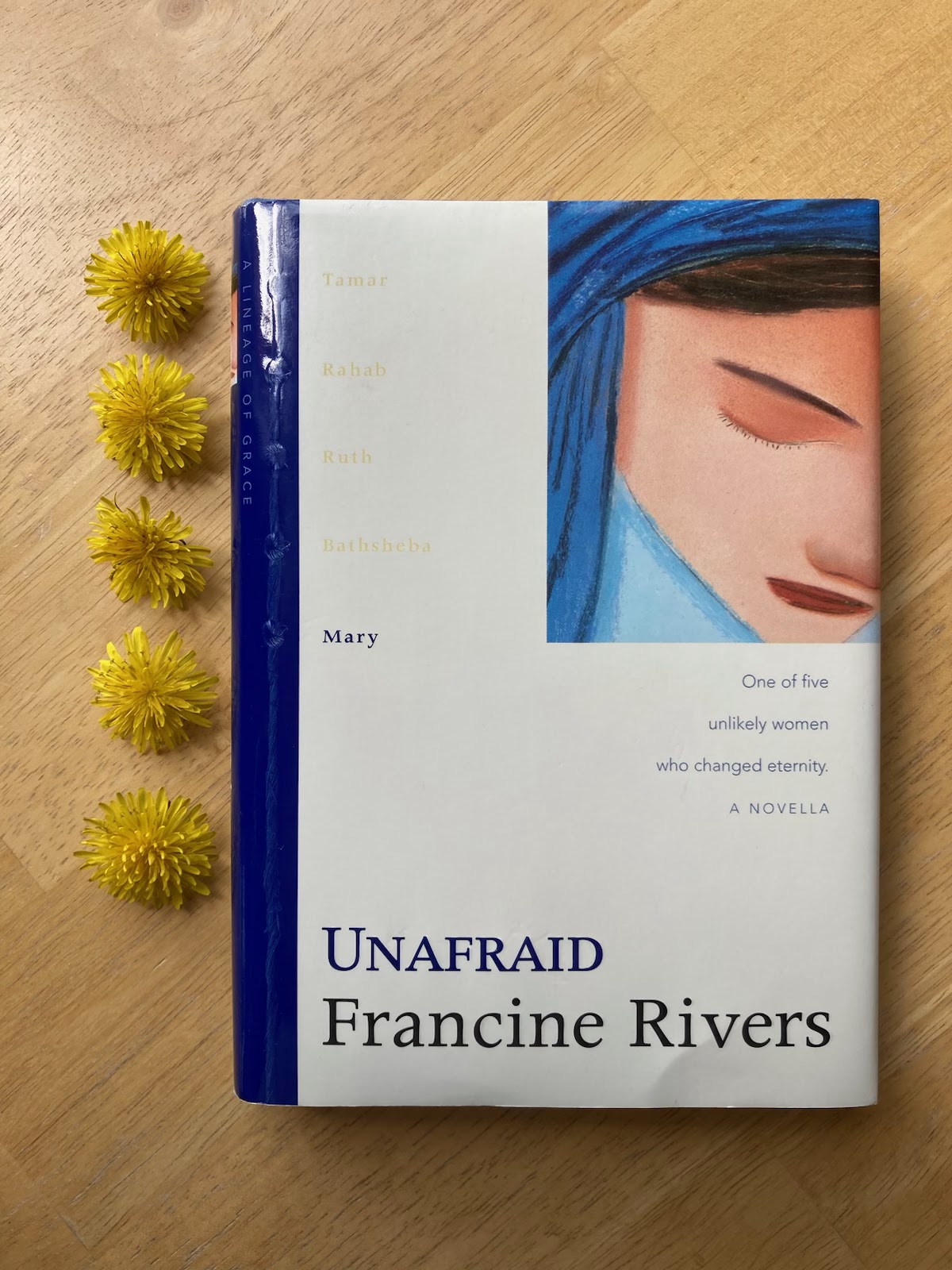
Let's Bust a Recap : A Lineage of Grace

Hi there! Summer is finally upon us (still a little weird living in a place where there are actual seasons) and I am loving it. Is it summer where you live and what are your favorite summer activities? Do you even like summer? Maybe we should get on to the recap. When I started working through Teresa Whiting's DisGraced study, I decided it would be a great time to revisit Francine Rivers' Lineage of Grace series. The first three women Teresa covers in her study are Tamar, Rahab, and Bathsheba, all of whom are in the lineage of Christ. So as I was working my way through DisGraced, I also took time to read through these five novellas by one of my favorite authors

This first book in the series brings the story of Tamar to life and was first published in April of 2000. You can read Tamar's story in Genesis 38. She's also mentioned in Ruth, 1 Chronicles, and, of course, in the lineage of Jesus in Matthew. Tamar's story is one of the harder ones to read about in Scripture. It's what I would call a rated R narrative, and even though culturally we're so far removed from what was acceptable in Tamar's day, it's hard to wrap your head around seducing your father-in-law and then bearing his twin sons. 

What I like about Francine Rivers' attempt to bring these women to life is that she starts each book with a note encouraging the reader to check out the actual Biblical account—with references—and she keeps the fictionalization to a minimum. Obviously, we can't know any details about these women beyond what the Bible provides, but I think Rivers does a good job of towing the line and not creating too sensational of a backstory or additional characters. In the case of Tamar, the thing that really stopped me in my tracks was the fact that they were literally dragging Tamar out to burn her alive when she sent Judah the proof that he was the father. Sometimes, when I'm reading a very familiar Bible story, I don't stop to think about how these real people were really feeling. How terrifying for Tamar, probably a very young woman in her 20s if not still a teenager at this point, to literally be staring down death and not even sure that Judah would relent once he received his things from her. My heart can't help but go out to her in her desperation. What a story. 

The second woman named in the line of Jesus is Rahab. This installment of Rivers' series was published just five months after Tamar's in September of 2000. Rahab's story can be found in Joshua 2 and 6, and she's also commended in Hebrews and James for her great faith. 

Rahab's is one of the more famous Bible stories. She was the Canaanite prostitute who hid two Israelite spies and, as a result, was saved from the destruction of Jericho when the walls collapsed. The thing that intrigued me about Rivers' picture of Rahab's life is the idea that she was looking out for the spies. I never gave it much thought as a child, but as an adult I've often wondered how the spies ended up at the home of a prostitute. I honestly don't think they were there for her *ahem* professional services, but why were they there? The idea that she was looking out for them in the hope that she could be rescued from the destruction to come seems plausible. Another interesting notion that Rivers posits is that Rahab ends up marrying one of the spies. From my reading of Scripture, we don't know the identities of the men who went into Jericho so it's something to consider. 

Now Ruth is one of only two women in Scripture who has an entire book of the Bible named after her and dedicated to her story. Francine Rivers' novella about her life was published in February of 2001. 

What came alive for me for the first time when I read Rivers' Unshaken was the connection between Rahab, Boaz, and Ruth. Rahab, the Canaanite prostitute was Boaz's mother. Of course Boaz would have an extra measure of compassion for outsiders. In fact, could the reason Boaz was an older unmarried man in Israel possibly be connected to the fact that his mother was Rahab? Perhaps Israelite fathers weren't keen to make that unsavory association. It's all very compelling to think about. The question this little novella raised for me was whether Rahab was still alive when Boaz married Ruth. I imagine that if she was, she lived in Boaz's house. Did Rahab and Ruth have a relationship with one another? Obviously, Ruth and Naomi were very close, but was Ruth able to develop an intimate relationship with her second mother-in-law? One that would offer her untold encouragement and support living as a Moabite woman among the people of Israel? I wonder. 

The fourth book in this little series is called Unspoken and it details Bathsheba's life as imagined by Francine Rivers. It was originally published about six months after Ruth's volume in August of 2001. You can read about Bathsheba in 2 Samuel 11 and 12 and 1 Kings 1 and 2. She is also mentioned in 1 Chronicles 3 and you can get even more insight into her life by reading Psalm 51, the psalm David famously wrote after committing adultery with her.

I think of all the books in the Lineage of Grace, Rivers takes the most license with Bathsheba's story. She starts with Bathsheba as an eight year old girl with a massive crush on the young giant-killer David. I don't think it's too big of a stretch to imagine that young Bathsheba idolized David—he was the biggest celebrity of his time—but to posit that her obsession with him continued even to the day of her wedding and beyond is maybe a bit much to believe. While I don't agree with the line of thinking that David raped Bathsheba, I also don't agree with Rivers that Bathsheba knew that David was watching her bathe and brazenly displayed herself to him. 

When I first read this novella as a young adult, I was intrigued by the idea that because of Bathsheba's situation, her friends and family may have shunned her, never speaking her name again. This thought becomes even more fascinating when you actually read the lineage of Jesus and see her referred to only as the wife of Uriah. 

Reading it this time around, I was more interested in Bathsheba's familial relations—her father being one of David's mighty men along with her husband Uriah, and her grandfather being one of David's trusted advisors. I even did a little fact-checking on this in Scripture and it all seems to track. I never made the connection that Ahithophel was Bathsheba's grandfather, and it's intriguing to think about how his granddaughter's relationship with David may have been a factor in his betrayal of David

Anyway, Bathsheba's story is pretty wild and I think Francine Rivers definitely gives her reader plenty to think about with the way she presents it. 

Ahhh, Mary. Sweet virgin mother of Jesus. Certainly the most famous woman in Scripture and arguably the most famous woman to ever live. This last novella in the series was published in October of 2001 meaning all five books in the series were published in the span of a year and a half. It's hard to pick out just a few passages about Mary to refer you to her story in the Bible when her life was so intimately intertwined with the life of Jesus, but some key references include Luke 1-2, Matthew 1-2, John 2Mark 6, Matthew 12, John 19, and Acts 1

I think of the five novellas in the Lineage of Grace, I read Mary's with the most caution. As I mentioned at the beginning of this post, Francine Rivers herself is quick to point the reader back to the Biblical accounts of these women's lives and it's a reminder that bears repeating. But having said that, I think Unafraid may offer the reader the most to think about and discuss. While we can't possibly know for sure if Rivers is right in her depiction of Mary's understanding of Jesus' purpose or her impatience in wanting him to assert himself as the promised Messiah, everything she writes in this little novella is extremely plausible, and Mary's thoughts and attitudes are natural human responses to the situation she found herself in. There's so little we know of Jesus' growing-up years on earth, and Rivers does a fantastic job of sparking the reader's imagination in thinking about what those years may have been like. I especially liked her depiction of Joseph's relationship to the Christ-child and how she imagined Jesus with his brothers and sisters. I hope we get to know more about Jesus' earthly life when we get to Heaven. It's something I wonder about often. 

All in all, I would recommend the Lineage of Grace series with the exhortation to read them as companions to the original Biblical accounts, keeping in mind that these are just ideas of what it may have been like for these women. I'm a fan of anything that makes me think more deeply about Scripture and I love when something can make Scripture come alive for me. I think this series by Francine Rivers does a great job of both. But ultimately, it's the Word of God that will never pass away and I can't emphasize enough how important it is to keep His Word central when we're consuming Bible-based media and entertainment. 

Is there a particular story from the Bible you wish you could have witnessed? Or a person from the Bible you wish you could have lunch with and pick his or her brain?