Showing posts with label 19th Century. Show all posts

Tuesday, May 5, 2026

Let's Bust a Recap : Alice's Adventures in Wonderland and Through the Looking-Glass

Curiouser and curiouser. 

Despite the fact that I've had, not just one, but two copies of Lewis Carroll's most famous work sitting on my shelves for years (we got that Barnes & Noble edition in 2015 for our anniversary!), I just got around to actually reading these classics for the first time ever last week. And I have to tell you: it was not the best of times.

Both our copies contain both Alice's Adventures in Wonderland—originally published in 1865—and Through the Looking-Glass—originally published in 1871. Alice's Adventures in Wonderland was an immediate success upon publication and is now one of the best-known—and many scholars even say most important—works of Victorian literature. It has never been out of print and has been translated into 174 languages. Through the Looking-Glass did equally well, and both novels have been adapted for the screen, radio, ballet, opera, musical theater—even board games and theme parks! 

If you're unfamiliar with Carroll's greatest successes (which would be difficult to believe given their enduring popular appeal), in his first novel—a pillar in the genre of literary nonsense—Alice falls down a rabbit hole into a fantasy world of anthropomorphic creatures. She grows to dizzying heights and shrinks into almost nothingness by eating or drinking different things, she cries a literal ocean of tears, she contends with the disappearing Cheshire cat, she plays an insane game of croquet in which the balls are live hedgehogs that get up and run away and the mallets are also live flamingos whose necks flop around, and sasses the King and Queen of Hearts who are constantly putting everyone on trial because the Queen can't stop screaming "Off with their heads!" at everyone she comes across. 

It's a strange, fever-dream of a story—a baby turns into a pig, for crying out loud!—and Through the Looking-Glass is much the same only this time, Alice enters a fantasy world through a large mirror and finds herself in a place where everything is backwards and she's trying to become a queen in a game of chess. She talks to live flowers, meets the severe Red Queen and the flustered White Queen, quarrels with Tweeledum and Tweedledee, discovers how rude Humpty Dumpty is, and finally becomes a queen herself at which point she is named the host of a chaotic banquet. 

I didn't particularly enjoy any of it. 

As I've said many a time, children's literature may be my very favorite genre in all of literature. I was expecting to at least appreciate Alice for its place in the canon, but instead of coming off as charming, Alice only read as strange to me. It was dark and weird and, at times, even unsettling. Alice herself was sometimes precocious but mostly bewildered, and while it was certainly imaginative, it wasn't imaginative in a fun or even particularly playful way. I just couldn't get into it, and I didn't care for it. Frankly, I'll never forgive Lewis Carroll—or shall we call him by his proper name: Charles Lutwidge Dodgson—for calling daisies the worst of the flowers, and for not making any of the flowers especially pleasant, for that matter! 

I guess none of this should come as a major shock to me since I always thought the classic animated Disney film was rather strange, and if Disney can't make something sparkle, then the source material must be pretty dark. Alice's Adventures in Wonderland and Through the Looking-Glass have both been picked apart and analyzed to death by critics and scholars the world over for all its symbolism, linguistic puns, mathematics, fantastical rules and games, and all the nonsense. I cannot be the least bit bothered with any of that, and so I'm done with Alice. I doubt I'll ever revisit these novels though they will remain in my library for their classic status, and I will happily lend them to any of my friends or family who care to read them. 

But I wouldn't personally recommend them, and I'm truly puzzled as to exactly why they are so beloved. 

Do you like Alice and her strange adventures?

Monday, January 12, 2026

Let's Bust a Recap : David Copperfield

Um, you guys? I snapped this photo on a sunny fall day in November...of 2023.  

David Copperfield first made an appearance on my annual book lists in 2019 when I was trying out my first reading challenge. I put him in the category of a book published before you were born. (1850 for those wondering. A solid 137 years before I was born.) He then took up residency on my book lists in 2020, 2022, and 2023 at which point I did finally pick him up to start reading. In February. I was so determined to finally read this doorstop that year. But, if memory serves, I only got about ten chapters under my belt, and then left him largely ignored in my book cart for 2024. 

As you now know if you read my end-of-year recap on New Years Day, my secret goal for 2025 was to finish David Copperfield. And despite picking up the book several times throughout the year to try to start a streak of reading a chapter a day until I finished, I barely scraped by, finishing on the very last day of 2025 reading the final four chapters. I can only attribute my difficulty with David Copperfield to psychological warfare because it wasn't a particularly challenging novel to read. I enjoyed it every time I picked it up. But the sheer length (64 chapters, 877 pages) meant that every time I finished a chapter, it seemed like I hadn't made a lick of progress. And for whatever reason, that made it feel like a slog. On top of that, I wouldn't call David Copperfield a plot-driven novel so there was no big impetus to keep picking him up. I could pop in and out of old Trot's life story whenever I wanted and didn't feel any big drive to stick with him. I think by the time I got to December last year, I still had about half the book left to finish. Crazy.

David Copperfield is famously known as Charles Dickens' "favourite child" which is how he described it himself in his second preface to the completed novel. It just goes to show you there's no accounting for personal taste because of the three Dickens I've read, David Copperfield has been my least favorite. I loved Great Expectations and I was fully blown away by the masterful storytelling in A Tale of Two Cities. David Copperfield is the life story of the titular character who is telling us the story himself. The first chapter is literally titled "I am born" and we just go on from there as David recounts the death of his little mother, the harsh treatment he endures from his stepfather and stepfather's sister, running away to find his aunt Betsey Trotwood, the girls he falls in and out of love with, his friendships—ill-fated or otherwise, his rise to fame as an author, and so on and so forth. It's not what I'd call compelling, but it is known to be Dickens' most autobiographical work so it makes sense that Copperfield is his favorite. 

Dickens' greatest strength in David Copperfield (in this reader's opinion, anyway) is his character sketches. I can't tell you how much I loved, loved, loved Betsey Trotwood. Definitely a new all-time favorite literary character. I loathed Uriah Heep. I rooted for Mr. Peggotty. I admired Tommy Traddles. My heart went out to Martha and Little Em'ly. I wanted to smack the smug "respectability" off of Littimer and wring Steerforth's worthless neck. I couldn't roll my eyes hard enough at ridiculous Mr. Micawber or his wife. And poor little Dora. As far as I'm concerned, she and Doady deserved each other and Agnes really could have done better. I could go on but suffice it to say, Dickens is a master at giving us fully fleshed out characters who feel real and timeless 175 years later. 

As for David Copperfield himself—Davy, Trot, Doady; whatever you prefer to call him—he was a bit insufferable, very much like Victor Frankenstein. I don't know if it's the device of having the character narrate their own story that takes away a measure of their likability for me, but at times I was groaning for old Trot to just get on with it already or to grow up for Heavens' sake. Which he ultimately did, but with all of Dickens' colorful cast of characters, Davy himself was the one I could have done without. I'm not sure what that says about me, but there you have it. 

Just this past February (probably during one of my hapless attempts to get back on the Copperfield wagon), I stumbled across this 2024 Forbes article which, among other things, posits Dickens' ten greatest books and ranks them in order. I found that I had unknowingly started my own Dickens journey in the correct order (according to the article) and so I plan to keep working my way down that list in future. It may be a few years before I pick up another Dickens, but when I do, it'll be Oliver Twist which is what comes next on the list. (Although I may have to sneak A Christmas Carol in somewhere because it doesn't make the top ten since it's not a full-length novel and I've never actually read it. I know. The horror.)

All said, it feels good to finally close the loop on David Copperfield. He has without question shown up on more book lists than any other book I own and finishing him feels like a small kind of accomplishment

Monday, December 15, 2025

Let's Bust a Recap : Frankenstein

Well, here we are, ten days till Christmas and what am I recapping on the blog today? Some cozy holiday story á la The Best Christmas Pageant Ever? No. Today we're talking about what is possibly the most classic horror story of all time. The story of Doctor Victor Frankenstein and his creature.  

"It was on a dreary night of November that I beheld the accomplishment of my toils..."
When I heard last year that Guillermo del Toro was making a new adaptation of Frankenstein to be released in 2025, I knew it was time to finally read my copy of this classic and so I added it to my book list and planned to read it in October or November around the time the movie was slated to be released. Despite the enduring fame of this 200 year old ghost story, I knew relatively little beyond the fact that "Frankenstein" is the name of the doctor, not the monster. *insert massive eye-rolling about here* My lit teacher friends have all told me that this is one of those accessible classics that even high schoolers love and that I'd breeze through it, easy peasy. 

Well, yes and no. First of all, Frankenstein is a bit convoluted in that it's a story, inside of a story, inside yet another story. The preface begins as a series of letters from a certain Captain Walton who is on an expedition to the North Pole. As it happens, the captain met with some strange circumstances in which he picked up a lone man called Victor Frankenstein who determines to tell Walton his history. As a young man, Frankenstein was fascinated with alchemy and, through a series of events, discovered he could create life. After piecing together a bodily form from cadavers, he actually does succeed in animating his creation and then immediately regrets it and runs away from it. I'm not going to get too into details here but after a lot of time passes, his creation finds Frankenstein and determines to tell him his own story and make a request of him. 

See what I mean? Convoluted. Which makes sense because Mary Shelley was a teenager herself when she wrote it. The teen angst is palpable in this novel. It's a brilliant story though and I get why the appeal of it has endured. The feelings that Frankenstein's creature (I will not call him a monster, I loved him too much) has to grapple with concerning his loneliness and where he belongs are all too relatable, and the consequences Frankenstein has to face as the result of playing God raise so many questions we're still asking ourselves today. 

But my expectations for this book were out of line with my experience when I finally picked it up to read it. The mind-numbing descriptions of the natural world were too much even for me and took me out of the story. Victor Frankenstein is one of the most insufferable characters I've encountered in a very long time. And the creature's story was by far my very favorite part of the book, but unfortunately it was also the most brief. (Or if it wasn't, it definitely felt that way.) After reading it and having a little time to think about it, I think it's a novel that bears re-reading with my expectations adjusted accordingly. 

As for the brand new film adaptation that came out November 7th on Netflix, I took a break from my annual slate of favorite Christmas movies yesterday to watch it. And I have a lot of feelings about it. The movie itself is absolutely beautiful. A sweeping epic if I've ever seen one. The love Guillermo del Toro has for the novel is apparent, even though he drastically changed the story in his screenplay. At first, I did not appreciate the liberties taken with the source material but as the film unfolded, del Toro's choices started to make a lot of sense to me. I'm still not sure how I feel about the twist ending, but on the whole, del Toro's Frankenstein is a film I'd watch again. Oscar Isaac and Jacob Elordi managed to bring the essence of Mary Shelley's original characters to vivid life on the screen and I felt the same way about the portrayal of their Frankenstein and his creature on film as I did when I was reading the novel. I don't say this about a lot of movies, but del Toro's Frankenstein is art. 

All things considered, I think Frankenstein is a fantastic story and definitely worth reading, but it's a slow burn so proceed accordingly. 

And if you've read it and you sympathize with Frankenstein and think his creature is a monster, let's talk about that because I'd love to hear your perspective. 

Thursday, October 24, 2024

Let's Bust a Recap : The Strange Case of Dr Jekyll and Mr Hyde and Other Tales of Terror

"Strange Case of Dr Jekyll and Mr Hyde is one of the most famous pieces of English literature, and is considered to be a defining book of the Gothic horror genre." So says wikipedia and so say I. I would even venture to say that Scottish author Robert Louis Stevenson is one of the most well-known authors of all time. Even if you haven't personally read his work, you're likely to recognize titles like Treasure Island or Kidnapped and know what they're about. 

I had never actually read Strange Case of Dr Jekyll and Mr Hyde for myself, but was familiar with the plot given how famous it is, and when Cody suggested we read it together during the power outage caused by Hurricane Helene, I immediately agreed. 

The story is narrated by a character called Gabriel Utterson, a lawyer and upstanding citizen who is friends with the titular Dr Jekyll. He becomes concerned for his friend's welfare after drawing up Jekyll's will and worrying that he is being blackmailed by a shady character called Hyde whom Jekyll has named his sole beneficiary in the event of his death or disappearance. Jekyll refuses to talk about it, but when Hyde murders another of Utterson's clients, Utterson confronts Jekyll directly. Hyde then disappears for a while, but through a twisty series of events, we learn that Hyde is Jekyll's evil alter ego and that because Jekyll has indulged this evil version of himself for so long, that side of his personality is taking over Jekyll completely. 

It's a fascinating study on good versus evil and the depravity of man. Stevenson posits through the character of Dr Jekyll that every human being has a great capacity for evil that they can either struggle against daily or completely succumb to. An interesting point to note is that the Dr Jekyll side of the dual Jekyll/Hyde personality is not completely good but has to face the normal human struggle of overcoming sin in his life; whereas the opposing personality of Mr Hyde is completely wicked and enjoys his wickedness—there is nothing good about him. 

Because I knew the famous story so well before reading it, the big reveal wasn't as shocking as I imagine it was for its original 19th century audience. But I was utterly fascinated by the plot nonetheless. 

The next story in this small collection is "The Body Snatcher", a short story first published in 1884. The characters in this story were based on criminals employed by the surgeon Robert Knox around the time of the notorious Burke and Hare murders in the early 19th century. Basically, this surgeon was buying corpses from these murderers to dissect during his anatomy lectures. In Stevenson's fictionalized short story, we see this play out from the perspective of the students employed to collect the corpses and pay the suppliers of these bodies. When the main character Fettes recognizes one of the bodies and is convinced that the woman must have been murdered, his comrade Macfarlane talks him out of reporting it, then later uses this against Fettes when Macfarlane himself kills a man and then brings the body in to Fettes for dissection and payment.

"The Body Snatcher" is a case study of the human conscience as both men are overcome with the guilt of what they've done. I found both Stevenson's Jekyll and Hyde and Body Snatcher stories all the more interesting knowing that Stevenson himself rebelled against formal religion and his parents' teaching and called himself an atheist for a time before ultimately coming back to some form of his faith later in his life. 

After "The Body Snatcher", Robert Louis Stevenson's short story "Olalla" first published in 1885 was included in this collection. "Olalla" is a Gothic romance. In it, an unnamed Scottish soldier is telling his story of taking up residence with a once-noble local Spanish family at his doctor's recommendation during his convalescence. Although he is offered a room under the stipulation that he remain a stranger to the family, he is heartily welcomed by the son and soon begins a casual friendliness with the mother as well. When he finally catches a glimpse of the daughter, he immediately falls madly in love with her and she with him. But after a terrifying scene in which the mother attacks the soldier, Olalla begs him to leave. 

"Olalla" has sometimes been interpreted as a vampire story, however Stevenson's narrator clearly regards the mother's actions as the basest of animal instincts and does not ascribe any supernatural reasons to her behavior. For pure entertainment value, I enjoyed "Olalla" the most in this collection because I knew nothing about it and had no idea what was going to happen.

Finally, an abridged version of Stevenson's 1888 essay "A Chapter on Dreams" was included at the end of this collection. This contains some of his musings on dreams and nightmares and how he often remembered his dreams and adapted them into his work. It makes sense that this was included since "Olalla" and Strange Case of Dr Jekyll and Mr Hyde were both based on dreams Stevenson had. It was interesting to read, but I wish they had just included the entire essay instead of an abridged version. 

All in all, a great little collection and much spookier, in my opinion, than The Haunting of Hill House

Have you read any of Robert Louis Stevenson's work? Am I the only one who thinks of The Pagemaster whenever Jekyll and Hyde crop up in pop culture references? 

Tuesday, October 15, 2024

Let's Bust a Recap : Far From the Madding Crowd

Halfway through October already? Say it ain't so. I can't believe we only have two and a half months left in 2024. It's high time we moved to a Tuesday/Thursday posting schedule because I am so behind on recaps. The chances of me ending this year caught up around here are slim to none, but we'll give it the old college try like always. This week, I want to talk about book to film adaptations because 2024 has unintentionally become my personal Read the Book Before I Watch the Movie Year, and you know what? I don't hate it and I also don't see this trend ending any time soon. I already have at least two books slated for next year that fall into this category and it's just fun. It envelops two of my favorite hobbies. If y'all think my home library is out of control, don't even get me started on our DVD collection. My siblings call me the family archivist because I like my physical media, okay? I won't apologize for it. 

But where were we? About to start a recap? Let's get back to that.
Today's subject is the 1874 Thomas Hardy classic Far From the Madding Crowd. And why do I have three copies pictured? Because I definitely suckered my sister-in-law into reading this with me and when she brought her copy home from the library, my mother totally stole it and joined in which resulted in me checking out another copy for Caroline to read. And in case you, like me, need to know every single detail about every single thing: my copy is the red one in the middle, my mom read the Macmillan Collector's edition on the top, and my sister read the shabby green copy on the bottom.

Far From the Madding Crowd is the third Thomas Hardy novel I've read. My first introduction to his work was back in 2017 when I read Tess of the D'Urbervilles. Which I loved. I followed that up by reading The Return of the Native in 2018. Which was a total slog. So I took a break from Hardy even though I had three more of his novels sitting on my shelf. But at the beginning of the summer, I picked up the 2015 film adaptation from my Friends of the Library for a measly fifty cents and immediately convinced my sister to buddy-read it with me so we could watch the movie together. And it fell somewhere in between. I definitely enjoyed it more than The Return of the Native but it can't touch Hardy's masterpiece, Tess of the D'Urbervilles

In Far From the Madding Crowd, we meet Bathsheba Everdeen who is a stone-cold fox. She ends up inheriting a large farm from her uncle and determines to become a successful, independent lady-farmer—obviously a rarity in 19th century rural England—but the crux of the plot centers around the three very different men who fall in love with her and attempt to woo her. Gabriel Oak, a hard on his luck shepherd who after a devastating reversal of fortune finds himself in Bathsheba's employ; William Boldwood, a prosperous, middle-aged farmer whose estate borders Bathsheba's; and Frank Troy, a dashing sergeant stationed in nearby Weatherbury. Will Bathsheba relinquish her cherished independence and get married? And if so, who wins her heart? You'll have to read it to find that out. Hardy fills out his novel with a host of colorful characters including all the salt-of-the-earth men who work Bathsheba's farm. These guys were my mom's favorite part of the book. They were hilarious and she was very disappointed that the malt house scene was not included in the film. 

And speaking of the film, we watched it this past weekend and we all agreed that it was very well done. I think it goes without saying that the book is always better, but you could tell that a lot of care was taken when adapting it for the screen, and the actors chosen acted the crap out of it. We were all on the edge of our seats the whole movie, including my mother-in-law who did not read the book. While it felt a little rushed and Carey Mulligan did not fit my mental picture of Bathsheba Everdeen, overall the movie was excellent. Mulligan, Schoenaerts, Sheen, and Sturridge did a phenomenal job of bringing the four principal characters to life. Even despite Mulligan not looking like the Bathsheba I pictured, the casting for this film was perfection.  

If you're only going to read one Thomas Hardy in your life, I'd direct you to Tess of the D'Urbervilles. But Far From the Madding Crowd was a good time and slightly lighter than the absolute tragedy that is Tess's life. If you like a good classic, I'd recommend it, and for a wonderful period piece, definitely check out the 2015 adaptation starring Carey Mulligan

Do you read the classics? Who's your favorite 19th century author? 

Tuesday, August 15, 2023

Let's Bust a Recap : Sherlock Holmes

Welcome one and all to the third week of August in the Year of Our Lord 2023 which will otherwise be known on this blog as "The Week We Try to Clear the To Be Blogged Stack of Books Read in 2022". We're close, y'all. So close. And in an effort to accomplish our goal, today I'll be talking about Sir Arthur Conan Doyle's first two short story collections featuring everyone's favorite sleuth: Sherlock Holmes. 

Way back in 2021, I picked up Conan Doyle's first novel in which old Sherlock appeared, and devoured it in about a day. A few weeks later, his second novel met the same fate. Shortly after that, I began on The Adventures of Sherlock Holmes, confident that I would finish it and also The Memoirs of Sherlock Holmes before 2021 was through. 

...and then stalled for nearly a year. What can I say? I swing for the fence. It turns out, I have a lovely habit when it comes to short stories of reading one or two, and then forgetting the rest of the collection for months on end. This bears no reflection on the stories themselves, just on my personal attention span. Sherlock Holmes' short stories are so individual in nature and each one is so satisfyingly wrapped up that there is no narrative drive to continue reading them until you're finished. (At least not for me anyway.) The Adventures of Sherlock Holmes were a rip-roaring good time. I just managed to stretch these twelve short stories from July of 2021 to April of 2022. In this collection, we get our first introduction to the enigmatic Irene Adler in "A Scandal in Bohemia". She's one of the only people to ever outsmart Holmes, and she's so clever about it that it makes this story one of Conan Doyle's personal top twelve. I hope we see more of her. His other stories cover a range of bizarre stories involving the KKK, a bank robbery, and even a goose with a precious jewel stuffed down its throat. Of the twenty-three short stories I've read so far, this collection contained my two personal favorites; number one being the horrifyingly creepy "The Speckled Band", and number two being the delightfully hilarious "The Red-Headed League". Coincidentally, in doing a little research for this post, I discovered that these are also Conan Doyle's two favorite stories out of all the Holmes mysteries that he wrote. Cheers to that! I also really liked "The Man With the Twisted Lip" from this collection.

I did a little better with the next set, starting them in April and finishing them in October of the same year. The Memoirs of Sherlock Holmes is Conan Doyle's second collection of short stories about Sherlock (eleven of them this time) and the one that was meant to end the character for good. When "The Final Problem" was first published in The Strand Magazine in December of 1893, the public outcry was so severe that The Strand almost went out of business. Conan Doyle was eventually convinced to resurrect the beloved character and went on to write two more novels and thirty-three more short stories about him. 

In this collection, we get to read about Holmes' very first case in "The Adventure of the Gloria Scott", one of the uncommon instances where we hear the case from Holmes' perspective as he recounts it to Dr. Watson. We also are introduced to Holmes' brother Mycroft in "The Adventure of the Greek Interpreter", in which we learn that Mycroft is even smarter than Holmes' but is too lazy to actually pursue detective work. And of course, we also meet Sherlock's famous nemesis Professor Moriarty in "The Final Problem" in which Sherlock presumably goes over a cliff taking Moriarty with him to their deaths. 

The cases in this collection had a more melancholy feel to them, and my favorite was easily "The Adventure of the Yellow Face" which was heartbreaking but had a beautiful ending. From this collection, Conan Doyle ranks two of the stories in his personal top twelve: "The Final Problem" and "The Musgrave Ritual". 

If you start with the novels (which I did), you're already aware of Sherlock's general disdain for law enforcement or, really, authority of any kind, but in reading these first two collections of short stories, it was interesting to see Sherlock's personal sense of justice. There were multiple stories wherein Sherlock doesn't actually out the culprit for reasons he deems worthy, whether it's because he thinks they'll pay for their crimes in other ways due to the life choices they've made, or that they're old and about to die anyway, or even because he is certain that it will bring them too much embarrassment to try anything underhanded again...or that they're too chicken. 

All in all the stories are so fun to read purely because of how absolutely bizarre the cases and how ingeniously Sherlock manages to solve them. The economy of language Conan Doyle employs in writing them make them quick reads, easily ingested in a single sitting. I remember toting my large, hardcover copy with me to work so I could squeeze in a story here and there on my breaks. I definitely would recommend reading at least one short story spotlighting the brilliant mind of Sherlock Holmes: once you start, you won't want to stop. And here's my personal suggestion to you: since these stories don't need to be read in any particular order to enjoy them, start with one of my favorites and let me know what you think!

Monday, January 16, 2023

Let's Bust a Recap : Twenty Thousand Leagues Under the Sea

Well, we've kicked off our 2023 reading strong...by finishing up the two books in progress I started last year. Ha! The first one was Twenty Thousand Leagues Under the Sea by French author Jules Verne. Cody and I started this one together back in September, and although we started well, our reading aloud time took a backseat when the holidays hit, and we were only reading a chapter or two (of the 47 chapter book) per week. 

Twenty Thousand Leagues Under the Sea was originally published in French in 1871. Like many novels being written around that time period, it was first serialized between 1869 and 1870. It was translated into English a couple of years later by Reverend Lewis Page Mercier. Even though it's pretty widely recognized that Mercier's translation isn't very good, it is somehow still the standard English translation with later translations recycling a lot of Mercier's mistakes. Since the 1960s, there have been several new and complete translations published, but the basic English copy you'd find in most bookstores is going to be some form of Mercier's translation which is what we have. (You gotta love those gorgeous Barnes & Noble special editions though, right?)

In Twenty Thousand Leagues Under the Sea, the year is 1866 and ships from many different countries are sighting what they believe to be some incredible sea monster all over the oceans. The United States government puts together an expedition to find and destroy this monster, and Professor Pierre Aronnax, a French marine biologist, is invited to go along. He is the narrator of our story which is written in the style of his personal journal and account of their ensuing adventures. His faithful assistant Conseil, and a Canadian harpooner named Ned Land are our other two principal characters. When the expedition finds the monster and attacks it, these three find themselves hurled off the ship and save themselves by climbing onto the monster itself which they are surprised to discover is no monster, but a futuristic submarine. They are eventually taken aboard and meet the inventor and commander of the vessel, the mysterious Captain Nemo who informs them that to maintain the all-important secrecy of his watercraft, they will remain as permanent inmates on the Nautilus

What follows is a detailed account of their time on board and the many adventures they encounter. While Verne has a dry sense of humor that had me laughing out loud at times, and the actual adventures are thrilling, the in-between bits were just boring. There were chapters where all Aronnax was doing was describing the various sea life, explaining the mechanics of the Nautilus, or chronicling their travel from place to place. There was a lot of math and a lot of scientific names that I twisted my tongue trying to pronounce as I read this aloud to Cody, and frankly, I'm more of a lit/history lover than a maths and sciences nerd. But overall, I'd say the exciting parts outweighed the boring parts making this classic one worth reading. However, my enthusiasm for our other Jules Verne books has been tempered accordingly. (We also have Around the World in Eighty Days and Journey to the Center of the Earth.) Being that I don't speak French, I'm not sure what all was lost in translation, but Cody and I both enjoyed the humor in Twenty Thousand Leagues Under the Sea and every so often, I'd come across a simple line that stopped me in my tracks and I'd look up at Cody and say, "What a great line!"

So do Aronnax, Conseil, and Ned Land ever escape the Nautilus? For that, you'll have to read this one for yourself. 

Thursday, October 13, 2022

Let's Bust a Recap : The House of the Seven Gables

Ok, so The House of the Seven Gables was our book club book for the month of July, and I'm just going to say right off the bat that this is NOT a July book. I don't know how much importance you place on the seasons when you're reading, but atmosphere is huge for me, and Nathaniel Hawthorne and his Dark Romanticism is not a summertime author. 

But the book club decreed that this would be the book for July so at the end of July/beginning of August, there I was, struggling through Hawthorne's 1851 offering about this old haunted mansion in New England.

I actually wasn't dreading it. I knew July probably wasn't the best time to read The House of the Seven Gables, but The Scarlet Letter is one of my all-time favorite classics and I'd had Hawthorne's follow-up novel on my shelf for years waiting to be read. 

I'll just go ahead and tell you now: it wasn't great. It wasn't bad, and maybe if I had read it during the winter by a cozy fire, it might have garnered a more favorable review, but as it stands: I'll probably never revisit this one.

In The House of the Seven Gables, we're introduced to old Hepzibah Pyncheon who has been living alone in poverty in our titular House, and who—to her immense mortification—has finally resorted to opening a little shop in the House to support herself. Hawthorne opens his novel by giving us a never-ending brief history of the House and the Pyncheon family so by the time we meet Hepzibah, we know that the Pyncheons are cursed and the House of the Seven Gables is supposedly haunted. 

Throughout the course of this slow narrative, we meet the young and vibrant Phoebe Pyncheon (who comes to live with old Hepzibah and who breathes new life into the house), Clifford Pyncheon (Hepzibah's brother who also comes back to live with her after getting out of jail for murder—and who I legitimately thought was an actual ghost for a while), Holgrave (the boarder living in part of the House), and Judge Jaffrey Pyncheon (who we eventually learn set up Clifford for the murder he didn't commit). The main thrust of the plot is the reckoning between the three elder Pyncheons (Hepzibah, Clifford, and Judge Jaffrey) over Clifford's wrongful 30-year imprisonment, but man, we go through a lot of history to get to the point. 

And here's the thing: it really wasn't bad. Hawthorne is a masterful writer and one of my favorite aspects of The House of the Seven Gables in particular was the way he could paint a portrait of a character and without telling you how to feel about the character, he intrinsically made you feel a certain way about that character. His use of subtle sarcasm is absolutely superb, and his humor is biting. I'd recommend this book for the masterclass it is in writing alone.

But for all the good writing in the world, it was slow. I mean, good-luck-staying-awake, bless-you-if-you-can-finish-it, drink-all-the-coffee, thick-molasses-in-January SLOW. Getting through an entire chapter without falling asleep felt like a small victory, and it took me over three weeks to read it. (And it's not very long.) I think I was the only person in our book club who finished it. If you're going to pick this one up, adjust your expectations accordingly and settle in for the journey, because this one is a marathon—not a sprint. 

I saved a ton of quotes from The House of the Seven Gables and maybe one day when things settle down a bit, I'll share them here. All in all, this one is a take it or leave it. I wouldn't enthusiastically recommend it, but I wouldn't not recommend it either. I personally think The Scarlet Letter is loads better and would tell you to start there with Hawthorne, but The House of the Seven Gables was good too. Just not great. And don't try to read it in the middle of summer. 

Are you a seasonal reader? What's one of your favorite classics to read in the autumn?

Monday, August 9, 2021

Let's Bust a Recap : Sherlock Holmes

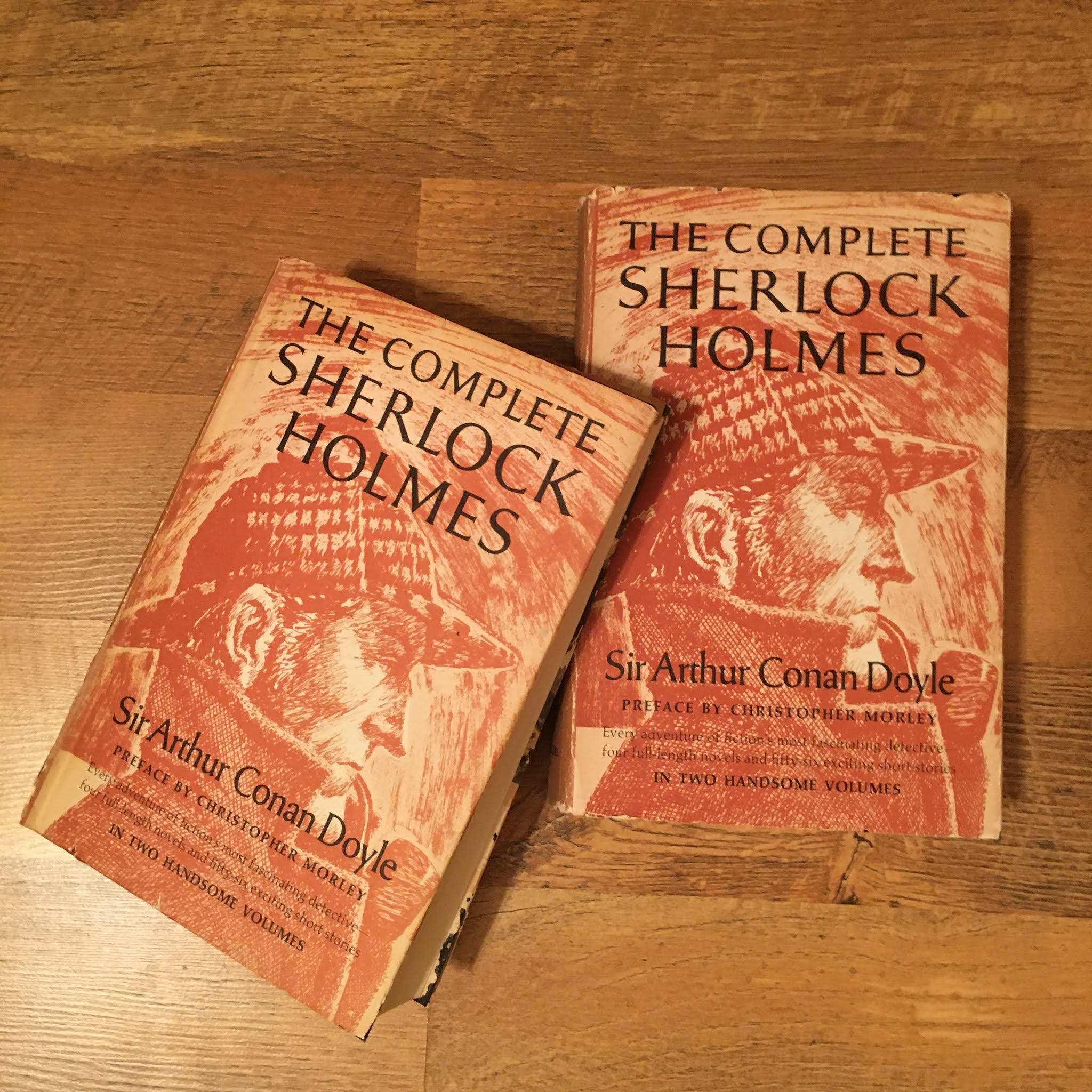
Well, at long last I have waded into the weird and wonderful world of Sherlock Holmes. Sherlock is one of those classic literary characters that I've always meant to read, but never got around to. We own The Complete Sherlock Holmes in "two handsome volumes" that Doubleday put out in the late 1920s. 
Because our Sherlock Holmes is all bound up in those two hefty editions, they sat on my shelf largely ignored for several years as classics I'd get around to someday. I didn't even know how many books Sir Arthur Conan Doyle had written about Sherlock or how they were compiled or anything until just this year. All I knew was that it was a lot and I didn't know where to begin. As it happens, right before our big move to North Carolina a few months ago, Cody and I snagged the BBC mini-series Sherlock on DVD from our Friends of the Library bookstore for a measly buck a season. After moving and getting settled in, we decided to start the show, and after watching the first episode, I decided it was time for my proper introduction to the OG Sherlock Holmes. 

So let me break down some of the quick facts for you: there were ultimately nine books Conan Doyle put out about the famous "consulting detective" Sherlock Holmes. Four novels, and fifty-six short stories which were originally published in magazines then later collected in five anthologies. The first (A Study in Scarlet) was published in 1887, and the final (The Case-Book of Sherlock Holmes) was published in 1927. Interestingly, Conan Doyle was ambivalent toward his popular creation. As the demand for Holmes stories grew, Conan Doyle actually wrote to his mother that he often thought of killing the character off and being done with him because "he takes my mind from better things." An idea which horrified his mother. In an attempt to scare off publishers, he raised his price level to what he thought was an unreasonable amount, but that didn't keep them away. He ended up becoming one of the best paid authors of his time. 

My "two handsome volumes" arrange the books of Sherlock Holmes chronologically according to the dates they were originally published individually and that's how I decided to tackle them. So in this post, I'll be talking about the first two novels: A Study in Scarlet and The Sign of Four. 

So this short novel was the world's first introduction to the now famous duo of Sherlock Holmes and Dr. Watson. Conan Doyle wrote it at the age of 27 in less than three weeks. 

The first part of the novel is written from the perspective of Dr. Watson as his diary. (Most of the subsequent stories about Holmes are written in this way—as Dr. Watson's reminiscences.) He recounts how he and Holmes came to meet and room together at 221B Baker Street in London, and then goes on to describe the first case he accompanied Holmes on involving a murdered man named Enoch Drebber. Shortly thereafter, Drebber's secretary Joseph Strangerson also turns up dead, and Holmes in his unorthodox and brilliant way figures the case out and apprehends the murderer. 

In the second part of the novel, we're abruptly taken back in time and across the ocean to the Salt Lake Valley in Utah in 1847 where a story unfolds about a man and little girl who are at the brink of death in the desert when they are rescued by a band of pioneer Mormons on the condition that they adopt the Mormon faith. 

Let me tell you, the transition between Part 1 and Part 2 of the novel was so abrupt and so unexpected that I spent a good bit of time wondering if this was actually two separate short stories and if we were ever going to figure out how Sherlock Holmes had solved the case in Part 1. As it turns out, Part 2 is the backstory of the two murdered men and their murderer, and it does all come together in the end. I was completely wrapped up in it, and just as impressed as Dr. Watson with Sherlock Holmes' uncanny ability to unravel the mystery. 

I have to add: Conan Doyle's unsparing and merciless depiction of Mormonism in this novel was a thing to behold. It took me by surprise, and I have to wonder, given Sherlock Holmes' universal popularity, if he has many Mormon enthusiasts and what their opinion of this first novel is. 

One other fun tidbit about A Study in Scarlet is that it was the first work of detective fiction to incorporate the magnifying glass as an investigative tool. 

The Sign of Four was Conan Doyle's second novel featuring Sherlock Holmes and his boon companion Dr. John Watson. It was commissioned in August 1889 by the American businessman Joseph Marshall Stoddart who was the managing editor of Lippincott's Monthly Magazine, and first published in the magazine in February 1890. 

This novel has a much more complex plot involving a stolen treasure, secret pacts among convicts and corrupt prison guards, poison darts, a one-legged man, and even a boat chase down the River Thames. It was quite a ride and I enjoyed every minute of it. 

We also get to meet Dr. Watson's future wife Mary Morstan in this novel, and we learn that Sherlock Holmes has a drug problem. It was a bit of a shock to open upon Holmes casually shooting up a solution of cocaine because he was bored by the recent lack of interesting cases with a disapproving Dr. Watson sitting by, annoyed. 

These first two novels were not particularly successful to start with, and it was the ensuing short stories that launched Sherlock's widespread popularity. I'm currently reading the Adventures of Sherlock Holmes and hope to also read the Memoirs of Sherlock Holmes to complete Volume 1 of The Complete Sherlock Holmes by the end of the year. I can't believe it's taken me this long in life to actually read some Sir Arthur Conan Doyle especially given my penchant for mystery stories as a kid. I thoroughly enjoyed his first two novels about Holmes and Watson. Conan Doyle's writing is sparse and to-the-point which makes for quick reading. His style reminds me a lot of Agatha Christie. It's easy to see how his influence has impacted the mystery writers that have followed him. So far the short stories are even more fun as they're easily read in one sitting, and it's no wonder they're so popular. I, for one, can now join the ranks of other Sherlock fans in recommending his strange cases to mystery lovers everywhere. 

Do you like a good mystery? Have you ever read any of Dr. John Watson's reminiscences about Sherlock Holmes? Do you prefer the novels or the short stories? 

Friday, December 11, 2020

Let's Bust a Recap : The Tenant of Wildfell Hall

Y'all. Today is a big day. Today, for the first time ever in 2020, the To-Be-Blogged stack is cleared. We are officially caught up, you guys, and it feels so good. I'll probably be finishing The Diary of Anne Frank later today, but that is neither here nor there. For this brief moment in time, there are no books sitting in a pile, waiting to be blogged about before returning to their rightful homes on my bookshelves. Please, join me in a happy dance.  

I picked up this pretty, clothbound edition of The Tenant of Wildfell Hall at Powell's in Portland, OR a few years ago (yes, on the same visit I bought All the Light We Cannot See), and have been looking forward to reading it ever since. It was also one of the books on my 2019 book list and I had planned to read it with a friend which is probably the reason I did not end up reading it. (Sorry, Jen!) Don't try to understand how my mind works. It's a wild place. 

The Tenant of Wildfell Hall by Anne Brontë was originally published in 1848 under Anne's male pseudonym "Acton Bell" and was an instant success. The novel is framed as a series of letters from Gilbert Markham (to his friend, Halford) about the events surrounding his introduction and subsequent friendship with a mysterious young widow (calling herself "Helen Graham") who arrives at Wildfell Hall (an old abandoned mansion in the neighborhood) with her young son and a female servant. Markham is writing these letters in 1847 but is referring to the time Helen first comes to Wildfell Hall in 1827. In the course of his letters, he reveals part of Helen's diary (which she gave to him) which flashes back even further to 1821. As we read her diary, we discover that Helen fell in love and married young thinking she could fix the flaws of her man because people get better, right?

Wrong. She finally ends up running away from her husband with her young son in tow in the hopes of preserving them both from her cheating, alcoholic husband. 

While the contents of The Tenant of Wildfell Hall may not seem very shocking to us today in the 21st century, the sensation it created in Victorian society at the time cannot be overstated. A woman supporting herself financially was one thing, but a woman leaving her husband and taking their child with her violated social convention and early 19th century English law. Critics today consider it one of the first feminist novels, but at the time it was published, Anne got roasted. Even her own sister Charlotte tried to prevent the re-publication of The Tenant of Wildfell Hall after Anne's death saying, and I quote, "'Wildfell Hall' it hardly appears desirable to preserve." People have speculated about Charlotte's motives for this, but I intend to agree with the class that thinks she was a jealous old hag. (Except not actually old since she wasn't even 40 at the time.)

Anne defended herself against the critics of her day in a preface to the second edition saying:
...when we have to do with vice and vicious characters, I maintain it is better to depict them as they really are than as they would wish to appear. To represent a bad thing in its least offensive light is doubtless the most agreeable course for a writer of fiction to pursue; but is it the most honest, or the safest? Is it better to reveal the snares and pitfalls of life to the young and thoughtless traveller, or to cover them with branches and flowers? O Reader! if there were less of this delicate concealment of facts—this whispering 'Peace, peace,' when there is no peace—there would be less of sin and misery to the young of both sexes who are left to wring their bitter knowledge from experience.
Okay, Anne! You go ahead with your bad self, girlfriend!

She goes on in the preface to stick it to the critics who suspected her feminine identity thereby dismissing her work, saying: 
I am satisfied that if a book is a good one, it is so whatever the sex of the author may be. All novels are or should be written for both men and women to read, and I am at a loss to conceive how a man should permit himself to write anything that would be really disgraceful to a woman, or why a woman should be censured for writing anything that would be proper and becoming for a man.
 I mean, she was sassy and I'm here for it.

A lot of critics, both in her time and even now, think the only reason her work has endured is through the reputation of her sisters and her connection as an author with them. I call foul. I intimated a few years ago after reading her first novel, Agnes Grey, that I thought her work was just as good (maybe even better) than Charlotte's and Emily's, and after reading The Tenant of Wildfell Hall, she has solidified her status as my favorite of the Brontë sisters. As opposed to their Romanticism, she was one of the few authors of her time who employed Realism and it rang true. During certain parts of Helen's diary where she is describing a party at which her husband and his friends are getting drunk, I was squirming with discomfort. She perfectly encapsulated the experience of being in that atmosphere. 

I loved Agnes Grey, but The Tenant of Wildfell Hall is Anne Brontë's true masterpiece. It's such a shame she died so young. (29!) I can only imagine what else she might have produced given more time and experience on this earth. I'm glad she's finally getting her time in the sun. I'm not the only Anne fan around these days. While The Tenant of Wildfell Hall isn't exactly a light, fun novel, I couldn't put it down and flew through it in less than a fortnight (as our Victorian authors like to say). If you're going to get into the Brontë sisters, don't sleep on Anne!

Have you read any of the Brontës' work? I still have Villette and Shirley by Charlotte to go, and I also have Emily's complete poetry that I haven't really gotten into yet. What's your favorite of the Brontë sisters' novels?

P.S. Shoutout to my husband's co-worker Amanda who helped me figure out which photo to post with this recap, and which to post over on my Instagram. Thanks, girl!

Friday, September 18, 2020

Let's Bust a Recap : Middlemarch

Ah, Middlemarch. The book that wouldn't end. This is not, in actuality, the longest book I've ever read, but it sure felt like it. I started reading this tome at the very beginning of March and didn't turn the final page until the tale end of July. Five solid months. Though to be fair, I largely ignored it for all of April. I know there are a lot of fans of this classic out there, but I can't say I've joined your ranks. 

Middlemarch was written by Mary Ann Evans under the pen name George Eliot and originally published in eight installments in 1871 and 1872. In it, we follow the lives of Dorothea and Celia Brooke, Reverend Edward Casaubon and Sir James Chettam, Tertius Lydgate and Rosamond Vincy, Fred Vincy and Mary Garth, and Camden Farebrother and Will Ladislaw among a host of others, but these were the ones I was most interested in so they're the ones I'll mention. They all live in the fictitious village of Middlemarch and the novel is mainly about who marries who and how that goes for them. While the portraits Eliot paints of each character are penetrating and real and the situations complex and compelling, none of the characters were likable (except Farebrother who ends up with the rawest deal of them all) and all the politics of early 19th century provincial life had me falling asleep every time I was trying to read (what a slog). I was expecting something in the vein of Jane Austen, but what I got was something akin to the wordiness of Dickens married to the obscure politics of Tolstoy. 

For all that, this is not a bad novel. My sister-in-law read this along with me (although she was smart enough to tackle it via audio) and when I finally finished (months after she did), I told her that the entire novel was almost worth it for the very last sentence of the book alone. I mean, Eliot writes the absolute glorification of and resulting disillusionment with marriage in the cases of Dorothea and Casaubon and Rosamond and Lydgate with heartbreaking accuracy. She portrays the ruinous effect a completely self-absorbed wife (*cough*Rosamond*cough*) or an indifferent, neglectful husband (lookin' at you, Casaubon) can have on a marital relationship with poignancy. And her depiction of the acute strain financial hardship puts on a couple was strikingly vivid. Eliot managed to evoke strong emotions in me with her writing; unfortunately, they were mainly the negative emotions of frustration and exasperation. I wanted to shake Dorothea and smack Rosamond around a bit. I think the biggest problem I had was that my expectations were out of line with what ended up being my actual experience. I went into books like Anna Karenina and The Count of Monte Cristo being intimidated by their length and the fact that they were classic works in translation, then ended up being pleasantly surprised; whereas I approached Middlemarch with enthusiasm and ended up being underwhelmed and a bit disappointed even. 

Overall, I don't regret reading Middlemarch. I maybe didn't choose the best time to read it or approach it with the right mindset, but after the deaths of Thackeray (in 1863) and Dickens (in 1870) George Eliot became recognized as the greatest living English novelist at that time and Middlemarch is largely considered her greatest work though I tend to agree with the critic who said it was "overwrought and would have benefited from hastier composition". Interestingly, I learned in writing this post that Middlemarch is included in the same list as Ballet Shoes (which I also read this year) of the BBC's 100 Most Inspiring Novels, and it shows up on most every list the BBC puts together of exceptional novels. 

Would I recommend it? I mean, probably not if we're being honest. It's not one I'll be revisiting in future; but for its place in the canon of Victorian literature it might be worth a go if you're willing to give it some time.

I have one other Eliot novel in my collection—Daniel Deronda—but after making it through Middlemarch, I may call it quits with Eliot and stick Daniel Deronda in a Little Free Library somewhere. 
What do you think? Do I need to give Eliot another chance, and if so, what book can I not miss?

Wednesday, July 22, 2020

Let's Bust a Recap : The Count of Monte Cristo

Well, the day has finally come. I'm going to try to put my thoughts together into a coherent post recapping The Count of Monte Cristo. I read this hunk of a novel last year, and it took me four solid months to do it. I started it at the beginning of June and made it to the end on the last day of September. When I finally finished it, I felt a bit lost. I had been reading it nearly every day for four months and was so fully wrapped up in the story that when it ended, I didn't quite know what to do with myself. 

I loved this story. Unlike The Three Musketeers by Dumas, The Count of Monte Cristo hooked me from page one and nearly every single detail was vital to the plot. Most translated editions of The Count of Monte Cristo are abridged and after reading the unabridged version, I'm really not sure how. The only part of the book that I thought could have done with a bit of editing was Luigi Vampa's complicated backstory. But I digress.

The film adaptation of The Count of Monte Cristo starring Jim Caviezel is one of my all time favorite movies and has been for several years. Up until last year, it was one of my secret bookish shames that I had never read the novel that inspired the movie. But have you seen the novel? It's huge. It definitely intimidated me. Because I've seen the movie approximately 534 times, and because I really invested a lot of time in reading the novel, I'm going to be comparing them and in doing so, I'll be discussing some major plot points that are definitely spoilers so if you don't want to know, this is your cue to exit. 

So for a quick overview: The Count of Monte Cristo is the story of Edmond Dantes' wrongful imprisonment (literally hours before his wedding to the beautiful Mercedes) and subsequent escape from the Chateau d'If. He then amasses an insane fortune that his prison mate the Abbe Faria told him the location of before his death, and then uses it to exact revenge on the three men (Fernand, Danglars, & Villefort) responsible for his incarceration.

The first major departure from the novel as depicted in the film is that the adaptation sets Edmond and Fernand up as best friends from the time they were young. In the film's version, Fernand is rich and privileged and jealous of Edmond's happiness despite his relative poverty. He's really eaten up over the fact that Mercedes is in love with Edmond, and ends up getting kind of roped into Danglars' plan to frame Edmond during a drunken fit.

In the novel, Edmond and Fernand do not give one flying rip about each other and Fernand is just as poor as Edmond but infatuated with Mercedes. He basically is just a tool of Danglars to frame Edmond, and, in my opinion, the least culpable of the three because he's just not very bright. 

Danglars is motivated to ruin Edmond because of his jealousy over Edmond's rapid success in their mutual career as merchant sailors. Danglars is the greediest, most ridiculous character of the novel and Dumas' portrayal of him is hilariously scathing. In the movie, Danglars really doesn't get much development past his initial involvement in the plot to sabotage Edmond, and that is truly a shame.

Villefort doesn't even know who Edmond is but when he recovers a letter Edmond was given by Napoleon Bonaparte addressed to Villefort's own father, he quickly destroys the letter and sentences Edmond to life in the Chateau d'If to protect his own political interests. This was actually portrayed perfectly in the film.

The thing that the film does not and could not possibly do is develop the multitude of characters and Edmond's meticulous and complicated plot of revenge. Or as he sees it, justice. Throughout the course of the novel, Edmond has several aliases and his revenge is a years long con on these men, much more than a matter of a few weeks or months as the movie might lead you to believe. He learns every intimate detail of their lives and their families' lives and employs all this information and his considerable fortune to bring each of these men to complete ruin. He drives Fernand to suicide after decimating his reputation, he bankrupts Danglars and has him begging for food which is the ultimate punishment for that sleazeball, and he literally drives Villefort insane in the most chilling and masterful plot of revenge I have ever heard of. 
four months : this book made it into a lot of photos
The novel obviously does a better job at developing the complexities of Edmond as well. As vicious and exacting as he is with the men who destroyed his life, he's as loving and solicitous of the people he deems worthy or feels indebted to. When his revenge is coming to the ultimate climax, he has to confront the fact that innocent people have been hurt as a result of his all-consuming crusade, and he wrestles with the morality of his actions. 

One thing I'll say: the movie and the novel both end somewhat abruptly each in their own ways, and to be honest, I don't necessarily prefer one over the other. Both endings play with their corresponding forms, but ultimately, they both leave me wanting more. 

Overall, I would highly recommend the book and the film. The novel is a masterpiece in its own right, and the movie is just plain good. Having been so intimately familiar with the movie gave me a good foundation with the major characters, and I really didn't have much trouble keeping everyone straight which seems to be the commonly held problem people have when reading the novel. The Count of Monte Cristo will certainly take an investment of your time to read, but in the end, I really think it's worth it.
Have you read The Count of Monte Cristo or seen the film starring Jim Caviezel? What book has taken you the biggest investment of time to read and was it worth it?

Monday, October 22, 2018

Let's Bust a Recap : A Tale of Two Cities

"It was the best of times, it was the worst of times..." So begins Dickens' best known work. A Tale of Two Cities was published in 1859, but was set during the historical period of the French Revolution and the Reign of Terror. In it, we meet the French Doctor Manette, his daughter Lucie, English banker Jarvis Lorry, Monsieur and Madame Defarge, Charles Darnay, Sidney Carton, and Miss Pross among others. 

At the beginning of the novel, we learn that Doctor Manette has been languishing in the Bastille, wrongfully imprisoned, for the past 18 years and is finally released to live with his daughter who had previously never known that her father was even alive. In the years that follow, Lucie and her father live comfortably in London with Lucie's childhood governess Miss Pross. Lucie marries and things are going well for the whole family until the French Revolution begins and her husband ends up going back to Paris to clear up some business there. Will his former status in Paris lead him straight to the guillotine? Will Doctor Manette's sympathetic position as a Bastille survivor save his son-in-law? Will anyone make it out alive?? 

This novel was brilliant. While it was a little slow getting started and slightly confusing following everyone's storylines, when Dickens brought it all together, it was truly a masterful tale and it's no wonder this is probably his most famous work. The sacrificial love displayed had me cheering for Miss Pross and crying for Sidney Carton. The bloodthirsty Madame Defarge made my skin crawl. And the gritty depiction of the Reign of Terror sent chills up and down my spine. 

After reading Great Expectations and now A Tale of Two Cities, it's easy to see why Charles Dickens is widely regarded as the greatest novelist of the Victorian era. His work was instantly popular and remains so today over 150 years later. Critics and scholars have recognized him as a literary genius. I would definitely recommend A Tale of Two Cities. It is a phenomenal novel.

Having said all that, where do I turn next? We have Charles Dickens' complete works, and I have no idea which to put on my 2019 book list. I'm thinking it has to be Oliver Twist, but then I start looking at the rest of the titles and my certainty wavers. What's your favorite Dickens novel? Which ones are the absolute must-reads? And who was your favorite character from A Tale of Two Cities?

*SHOUT-OUT to my Dad*
Have the happiest of birthdays! 
Thank you for always encouraging my love of reading and recommending all the best books.
You're the greatest and I love you forever.

Monday, July 2, 2018

Let's Bust a Recap : The Professor

Can we even believe it's July already?! The year is officially half over. Christmas is basically right around the corner, you guys. Somebody please make it slow down!

The first book I finished in June was The Professor by Charlotte Brontë. The Professor was actually the first novel Charlotte Brontë ever wrote. However, it was the only one of her completed novels that she was not able to get published during her lifetime, and honestly: I get it. It wasn't my favorite. From what I understand, she re-worked a lot of this novel into Villette which I own but have not read yet, so it will be interesting to compare the two when I ever get around to it.

This novel is about the young William Crimsworth (who I'm still not sure if I was supposed to like or not) and the story is written as a first-person narrative from his perspective. Through a series of events, he basically cuts ties with all his relations, moves to Brussels, and becomes an English teacher. 

The plot was mediocre (at best), none of the characters were likable (save one), and there was just enough French in this book to make me extremely frustrated that I don't understand French. My biggest and most important recommendation for you if you ever decide to read this book is to get an edition that has the French translated into English in the footnotes because there were times I was reading the book when I just wanted to scream. I was able to put enough together contextually to follow the story, but I'll tell you what, that's the first and last book I'll be reading from Kennebec/Chivers Press. (I bought this book in one of those $3 warehouses you see cheap billboards for on big-time roadtrips. Now I know why the books are so cheap.)

All in all, I wasn't impressed with The Professor, and I wouldn't really recommend it. Sounds like Villette would be more worth the time, and someday, I'll either confirm or deny that supposition on ye olde blog. Until that day, I say if you want to read Charlotte Brontë, go for Jane Eyre. 

Do you like the Brontë sisters? Which of their novels are your favorites? Least favorites? I have three left to complete my Brontë reading: Villette, Shirley, and The Tenant of Wildfell Hall. Any suggestions on which should come next?

Monday, June 25, 2018

Let's Bust a Recap : Anna Karenina

I have finished reading my first Russian novel. I realize this is not a very big deal in the grand scheme of things, but I'm feeling more than a little proud of myself for this small life accomplishment. It took me four solid months (February-May) to complete this 817 page monster but, to put that in perspective, I also read 11 other books (and started on 2 more) during the time I was working my way through this one and I really think that if I had given this novel my undivided attention, I could have read it in a much shorter span of time. 

Anna Karenina was written by the famed Leo Tolstoy and first published in serial installments from 1873 to 1877 with the first complete version of the novel appearing in 1878. Widely regarded as a pinnacle in realist fiction, Fyodor Dostoyevsky declared it "flawless as a work of art", William Faulkner described the novel as "the best ever written", and in a Time poll as recent as 2007 it was voted by 125 authors as the "greatest book ever written". Pretty high praise.

There are no less than 11 major English translations of Anna Karenina with the 1901 Constance Garnett translation (later revised in 1965 by Kent and Berberova) and the 2000 Pevear and Volokhonsky translation being the two foremost translations according to scholars. I read the Pevear and Volokhonsky version and while I often found myself wondering how much of the author's tone and impressions might have been lost in translation, I found the novel to be very readable and would recommend this translation to anyone looking to read Anna Karenina. 

The book itself is divided into 8 parts which are each broken up into several small sections (the longest having 35 sections and the shortest having 19). 

In Anna Karenina, we meet a myriad of characters but the main stories center around Anna herself and a man named Levin. While these two main characters do interact in the book, their stories are mostly separate from one another. Anna's story is mainly about her adulterous affair with the affluent bachelor Count Vronsky while Levin's story details his life as a wealthy country landowner, his marriage, the birth of his first son, and his struggle to accept the Christian faith.

The novel explores a variety of topics including gender, morality, religion, politics, and social class. Tolstoy's themes emerge naturally from the lives of his characters and I was constantly questioning what the author's personal views and motives for writing the novel might be. Tolstoy doesn't explicitly moralize and leaves it up to the reader to draw their own conclusions about the behavior of his characters. 

I was very impressed with Tolstoy's ability to capture the human experience in his writing, and I understand why this novel is considered a pinnacle in realist fiction. I could relate to the characters' experiences and emotions, and I often found myself wanting to slap Anna for her poor choices or getting impatient with her jealous inner diatribes against whoever she was mad at. I sympathized with Levin during his little marital scrapes and got annoyed with him whenever he went off on one of his whiny rants. Tolstoy had a gift for writing the human condition accurately but simply. 

The name game in this novel got very confusing, not only because my brain isn't used to complicated Russian names but also because the same character could be referred to by any number of complicated Russian names at any point in the book. Bless the translator who would just simplify this and call each person by one easy nickname for the entirety of the novel. (Scholars disagree with me on this, but I don't care. These names are ridiculous, y'all.) I also couldn't care less about the politics in the story. Parts 3 and 7 were particularly slow as I slogged through the evaluations of the feudal system that existed in Russia at the time and the political meetings several of the male characters attended to vote politicians in and out of office. Shoot me. 

I was also extremely underwhelmed by the ending of the novel. A seemingly minor plot point (Levin's faith) turned out to be the entire subject of the conclusion of the book and while it was interesting to peek into the Russian religious views of the 19th century, I was left feeling disappointed with some of Levin's spiritual conclusions particularly as they related to differing religious beliefs. The novel ended somewhat abruptly for me despite its crazy 817 page length. 

So would I recommend Anna Karenina? Not necessarily. Russian literature isn't for everyone. I personally have eight Russian novels on my Life List, and I think Anna Karenina was a great one to start with. If you're looking to branch into the Russian authors or round out your reading life that way, I definitely would recommend Anna Karenina. If you're wondering if this novel is indispensable to a well-rounded list of classic literature, I'll have to reserve my opinion on that until I get a few more of these Russians under my belt. Ultimately I'm glad I read it, and I sincerely hope I didn't peak too soon by choosing "the greatest book ever written" for my first Russian novel. 

Have you read any of the Russian greats? Tolstoy, Dostoyevsky, Pasternak, Nabokov? Which ones are an absolute must? Which one should I tackle next? Have you read Anna Karenina? What did you think of it? I can't wrap up this post without giving a shout-out to my little band of lit lovers who read this one with me. Y'all kept me going, and I'm looking forward to our discussion of this beast of a novel!