Showing posts with label mystery. Show all posts

Monday, June 3, 2024

Let's Bust a Recap : Lie Until It's True

Jessie Weaver's sophomore novel is out! I knew after reading Live Your Best Lie last year that I'd definitely read anything else Jessie had to offer so I went ahead and preordered Lie Until It's True and then read it immediately after it showed up at my door last month. 

Lie Until It's True zooms in on one of the secondary characters from Weaver's debut novel Live Your Best Lie, but this young adult murder mystery is not a sequel. In this one, we learn that the last three years of sixteen year old Amanda Pruitt's life have been consumed with a murder trial and she is more than ready to move on from it. She ends up spending the summer with her aunt who works at a historic (haunted?) hotel in Colorado. Her childhood best friend's mother has been accused of murder in what seems like an open-and-shut case, but Amanda is hoping to spark a deeper investigation into what happened using her popular true crime TikTok account. But when someone else turns up dead, Amanda finds herself a prime suspect and right in the middle of another horrible murder investigation. 

First of all, if you're going to read Jessie's books, I'd say read them in order. As I mentioned, Lie Until It's True isn't a sequel but it does take place after the events in Live Your Best Lie and if you read it first, you will be able to eliminate a suspect from her first book. 

Secondly, I'd say I liked Jessie's debut better than Lie Until It's True, but this new release is highly readable and the murder mystery aspect kept me guessing again. I liked the romance element in this one, the ghost story component was fun, and the entire novel had a very summer camp vibe that I liked a lot. I thought wrapping the book up with an Ask Me Anything section was a clever way to tie up some lingering questions given the way social media features in the book. But my main complaint from Live Your Best Lie—the rude language and casual misuse of God's name—seemed even more pervasive in Lie Until It's True, and I got tired of it quickly. 

All things considered though, I'm still a fan and definitely looking forward to what Jessie puts out next. While I, once again, might hesitate to hand this book to actual teenagers without caveat-ing, I would conditionally recommend it. And because of the contrasting haunted hotel/summer camp themes, Lie Until It's True is a good read year-round for all you mood readers out there. 

Who's your favorite murder mystery author?

Monday, January 8, 2024

Let's Bust a Recap : Series Update

Over the past few years, I have started reading through several of the series I've accumulated. Some series are tailor-made to be binged like your favorite TV show on Netflix. Finish one book, pick the next one up till you've reached the satisfying, final conclusion. (I'm lookin' at you Harry Potter, Lunar Chronicles, To All the Boys I've Loved Before, Penderwicks.) I love a good immersive, unputdownable series. But then there are others. Books that feature the same spunky protagonist(s), but that don't necessarily need to be read in order. Each book can stand on its own. And when you come to the end of one, you can wait a while before you visit with that character again. These are the series I want to look at today. I kept putting this post off hoping to finish another Flavia and/or Jeeves book by the end of the year, but it didn't happen and what with 2024 being the year of the TBR Jar, I'm ready to put these books back on the shelf and see where the winds take me.
First up: Flavia de Luce. I picked up the first Flavia book back in March of 2021 right as we were in the thick of selling our house in Florida and packing up to move to North Carolina. I loved this little mischievous 11 year old right off the bat, and I ended up reading the second installment in her series in November of 2022. The Weed that Strings the Hangman's Bag (pictured above) was published in 2010, a year after the debut The Sweetness at the Bottom of the Pie. In this episode of Flavia's exploits, a famous puppeteer turns up dead at the end of his own puppet show, and Flavia figures out that his murder is somehow connected to the suspicious death of a little boy from several years before. Can our feisty, poison-loving protagonist solve both cases? Of course she can, and Flavia was just as charming in this second novel as she was in the first, but I'll admit it took me a bit longer to get into this one. Because one of the cases involves the hanging of a five year old little boy, The Weed that Strings the Hangman's Bag was decidedly darker than The Sweetness at the Bottom of the Pie. But even so, I'm still a fan of the series and looking forward to continuing it. I wasn't able to get to the third book—A Red Herring Without Mustard—last year, but we'll see if the TBR Jar turns it up in 2024. 

Next up, we have the fourth installment in the Maisie Dobbs series. I first started Maisie Dobbs right after the world shut down in 2020. My parents have since read all seventeen books in the series, but I've steadily read one a year and am thoroughly enjoying them as they come. Messenger of Truth was published in 2006. Jacqueline Winspear has done a pretty admirable job of cranking a new one out almost every year since she started writing them and the final novel is set to be published this year. In this fourth chapter, if you will, Maisie is approached by an artist's twin sister after he falls to his death from some scaffolding on the eve of his major art exhibit. The police have ruled his death as an accident, but given the fact that the masterpiece of his show is missing, and no one knows what it even is, his sister is convinced there is more to his death. Here's the thing I'm coming to realize about the Maisie Dobbs books: they are set after the Great War and so far all of the mysteries that Maisie has been commissioned to solve are closely connected to the war. Without exception, these first four books have all made me deeply sad when I reach the end of them. I can't imagine that changing as we get closer and closer to the second world war. But despite the melancholy I feel when I read Maisie Dobbs—or perhaps even because of it—I think it's a phenomenal series, and taking it one book per year is the perfect pace for me. 

Finally, I read the first book in The Mysterious Benedict Society series this year. This first book in what is now a series of five was published in 2007 and remained on the New York Times Best Seller list for over a year. I saw these books all over the place and finally added them to my wishlist after my sister Caroline recommended them after reading the first two aloud with my niece and nephews. My other sister Lyndsey promptly got them for me for my birthday, and Bob's your uncle, I was reading the first one last year. The Mysterious Benedict Society chronicles the adventures of four clever children who are brought together by the eccentric Mr. Benedict and given a top-secret mission which basically amounts to them saving the known world. While I did really enjoy this middle-grade novel and all the fun riddles the kids have to solve in their audition to join the Society, it took me a while to get into it and ultimately took me over two months to read. There was definitely a turning point where I had to know what happens but it took a while to get there. 

All in all, I'd recommend any of these series and I'd love to see any of these come out of the TBR Jar this year. 

How do you approach book series? Do you like to binge them as fast as possible? Or stretch it out as long as you can?

Thursday, November 30, 2023

Let's Bust a Recap : Hallowe'en Party

You knew it was coming, right? As soon as Kenneth Branagh announced his newest Poirot adaptation earlier this year, I was faced with a conundrum: I already had The Murder of Roger Akroyd on my 2023 book list, but now, obviously, I needed to read Hallowe'en Party before seeing A Haunting in Venice. On top of that, shortly before hearing about the movie, I came across the book in a Little Free Library and had just added it to my collection. Literally. In February. Of this year. What's a girl to do? 

Come October I nearly had a fit. I strayed from my list freely and often this year, and, as evidenced by my little self-imposed check-in at the beginning of September, I was feeling the crunch to actually read the books I had put on my list. So I sat down with The Murder of Roger Akroyd and figured I'd just get to Hallowe'en Party whenever I actually planned to watch the movie. 

Well, the same friends who had us over to watch Death on the Nile notified me immediately after seeing A Haunting in Venice come available on hulu that I better get to reading, because we were going to have another watch party. 

Naturally, I obliged. 

In this slim mystery, Hercule Poirot is called by a spooked Ariadne Oliver after she attends a Hallowe'en party where a child is drowned in an apple bobbing tub. The famous author of detective novels is a personal friend of Poirot's, and she begs him to come investigate the crime(s) for himself. The child had declared earlier in the day that she witnessed a murder and so Poirot's mission is twofold: solve the murder of the child, and determine if the dead child really did witness a murder and solve that one too. 

Clever. 

Hallowe'en Party is one of Agatha Christie's much later novels published in 1969 and while it still had her telltale stamp of misdirection and numerous suspects, there was a maturity to this mystery that I thoroughly enjoyed. This is the first Christie novel I've read where I definitively figured out the whodunnit before the actual revelation, but the whydunnit still eluded me making the resolution as satisfying as any of her other books. Reading this one so close to The Murder of Roger Akroyd, I couldn't help compare the two, and this one was by far my favorite. 

The movie on the other hand was the most ridiculous adaptation yet. In Murder on the Orient Express, Branagh did a great job developing the suspects and laying out the mystery, but then royally screwed up the ending. In Death on the Nile, he dragged us through a horrendous adaptation but managed to end it perfectly. In A Haunting in Venice: it was a total free-for-all. Branagh basically took the character names from the book, lifted a few plot devices (like the actual Hallowe'en party, and the separate past and present murders), but then just made his own movie. Like, why

I mean, honestly, why?? I really can't get over it. It was awful. 

Even setting the novel aside, the movie just wasn't great; although, much to my own surprise, I enjoyed Tina Fey in the role of Ariadne Oliver. While it's certainly not how I imagined her as I was reading the book, Fey did a great job with the role. While I cannot in good conscience recommend that trainwreck of an adaptation to anyone, I would definitely recommend reading Hallowe'en Party. I will warn you that there are several child victims in this one, but if you can deal with that, this is a great mystery. 

And to end on a fun note: Agatha Christie dedicated this little novel to author P.G. Wodehouse. Because they enjoyed each other's books. You know I'm a sucker for a good dedication and this one made me smile real big. How fun.

Still waiting for your Miss Marple recs over here!

Tuesday, November 28, 2023

Let's Bust a Recap : The Murder of Roger Akroyd

The Murder of Roger Akroyd is one of the greatest mysteries of all time. And that's not just me talking. As recently as 2013, the British Crime Writers' Association voted it the best crime novel ever. Serialized in 1925 and published in 1926, The Murder of Roger Akroyd is Agatha Christie's sixth published novel and third to feature our favorite little Belgian detective Hercule Poirot. 

Well, I finally got around to reading it this year, completing my little three-book box set of "The World's Favourite Agatha Christie" that I purchased back in 2017 in anticipation of Murder on the Orient Express coming to the big screen. 

And it was a rollicking good time. In The Murder of Roger Akroyd, Dr. James Sheppard is assisting Hercule Poirot in the investigation and keeping account of the details in his personal diary (á la Dr. Watson and Sherlock Holmes) so he is our first person narrator. Akroyd turns up dead in his study—stabbed—sometime after 9:00 one evening right after the good doctor has left his presence. The doctor along with Akroyd's butler discover him after a mysterious phone call placed to the doctor at home alerts him something strange is afoot. Through a series of circumstances, Poirot is asked to help with the case though he is trying to live a quiet retired life in this supposedly sleepy little village called King's Abbot. In what I'm coming to believe is the typical Christie formula, nearly every single person is a reasonable suspect, but never fear: Hercule Poirot cannot be stumped. In this novel, we get blackmail, poisonings, suicide, love triangles, a secret marriage: it's all in there! The crazy twist ending changed the game for the genre, and The Murder of Roger Akroyd is a perpetual fan favorite the world over. 

My personal favorite aspect of this particular Christie novel is Sheppard's spinster sister Caroline whom he lives with. She's an absolute riot of a character and she singlehandedly elevated this mystery for me. Christie herself acknowledged that this character was possibly a precursor to her other famous detective Miss Marple, so now I'm pretty determined to finally choose a Miss Marple novel for my next Agatha Christie book

While I had a lot of fun reading The Murder of Roger Akroyd and would definitely recommend it if you're looking for a good mystery, I wouldn't say it's my new favorite. As I alluded to above, I'm starting to see a pattern to Christie's writing: multiple credible suspects, a flood of clues and red herrings to overwhelm the reader, and a brilliant resolution. I think reading one or two Agatha Christie novels a year is probably a good pace to avoid burnout, but maybe I'm judging too harshly after only reading a few (this one was my fourth). I'll be talking about another of her novels later this week which brings my Christie Total Read to five. I have about twenty-five more sitting on my shelf, and I've decided I must get to Miss Marple next.

So which one should I read?

Tuesday, August 15, 2023

Let's Bust a Recap : Sherlock Holmes

Welcome one and all to the third week of August in the Year of Our Lord 2023 which will otherwise be known on this blog as "The Week We Try to Clear the To Be Blogged Stack of Books Read in 2022". We're close, y'all. So close. And in an effort to accomplish our goal, today I'll be talking about Sir Arthur Conan Doyle's first two short story collections featuring everyone's favorite sleuth: Sherlock Holmes. 

Way back in 2021, I picked up Conan Doyle's first novel in which old Sherlock appeared, and devoured it in about a day. A few weeks later, his second novel met the same fate. Shortly after that, I began on The Adventures of Sherlock Holmes, confident that I would finish it and also The Memoirs of Sherlock Holmes before 2021 was through. 

...and then stalled for nearly a year. What can I say? I swing for the fence. It turns out, I have a lovely habit when it comes to short stories of reading one or two, and then forgetting the rest of the collection for months on end. This bears no reflection on the stories themselves, just on my personal attention span. Sherlock Holmes' short stories are so individual in nature and each one is so satisfyingly wrapped up that there is no narrative drive to continue reading them until you're finished. (At least not for me anyway.) The Adventures of Sherlock Holmes were a rip-roaring good time. I just managed to stretch these twelve short stories from July of 2021 to April of 2022. In this collection, we get our first introduction to the enigmatic Irene Adler in "A Scandal in Bohemia". She's one of the only people to ever outsmart Holmes, and she's so clever about it that it makes this story one of Conan Doyle's personal top twelve. I hope we see more of her. His other stories cover a range of bizarre stories involving the KKK, a bank robbery, and even a goose with a precious jewel stuffed down its throat. Of the twenty-three short stories I've read so far, this collection contained my two personal favorites; number one being the horrifyingly creepy "The Speckled Band", and number two being the delightfully hilarious "The Red-Headed League". Coincidentally, in doing a little research for this post, I discovered that these are also Conan Doyle's two favorite stories out of all the Holmes mysteries that he wrote. Cheers to that! I also really liked "The Man With the Twisted Lip" from this collection.

I did a little better with the next set, starting them in April and finishing them in October of the same year. The Memoirs of Sherlock Holmes is Conan Doyle's second collection of short stories about Sherlock (eleven of them this time) and the one that was meant to end the character for good. When "The Final Problem" was first published in The Strand Magazine in December of 1893, the public outcry was so severe that The Strand almost went out of business. Conan Doyle was eventually convinced to resurrect the beloved character and went on to write two more novels and thirty-three more short stories about him. 

In this collection, we get to read about Holmes' very first case in "The Adventure of the Gloria Scott", one of the uncommon instances where we hear the case from Holmes' perspective as he recounts it to Dr. Watson. We also are introduced to Holmes' brother Mycroft in "The Adventure of the Greek Interpreter", in which we learn that Mycroft is even smarter than Holmes' but is too lazy to actually pursue detective work. And of course, we also meet Sherlock's famous nemesis Professor Moriarty in "The Final Problem" in which Sherlock presumably goes over a cliff taking Moriarty with him to their deaths. 

The cases in this collection had a more melancholy feel to them, and my favorite was easily "The Adventure of the Yellow Face" which was heartbreaking but had a beautiful ending. From this collection, Conan Doyle ranks two of the stories in his personal top twelve: "The Final Problem" and "The Musgrave Ritual". 

If you start with the novels (which I did), you're already aware of Sherlock's general disdain for law enforcement or, really, authority of any kind, but in reading these first two collections of short stories, it was interesting to see Sherlock's personal sense of justice. There were multiple stories wherein Sherlock doesn't actually out the culprit for reasons he deems worthy, whether it's because he thinks they'll pay for their crimes in other ways due to the life choices they've made, or that they're old and about to die anyway, or even because he is certain that it will bring them too much embarrassment to try anything underhanded again...or that they're too chicken. 

All in all the stories are so fun to read purely because of how absolutely bizarre the cases and how ingeniously Sherlock manages to solve them. The economy of language Conan Doyle employs in writing them make them quick reads, easily ingested in a single sitting. I remember toting my large, hardcover copy with me to work so I could squeeze in a story here and there on my breaks. I definitely would recommend reading at least one short story spotlighting the brilliant mind of Sherlock Holmes: once you start, you won't want to stop. And here's my personal suggestion to you: since these stories don't need to be read in any particular order to enjoy them, start with one of my favorites and let me know what you think!

Friday, February 24, 2023

Let's Bust a Recap : Live Your Best Lie

Many moons ago when facebook was just a fledgling student networking site, I was attending a teeny tiny college where everybody knew everybody and we all gossiped—in person!—about everybody's business. One of my fellow coeds was Jessie Bell who is now Jessie Weaver, and exactly one month ago today, her debut novel was published. Live Your Best Lie is a young adult murder-mystery which will keep you guessing right up to the end. 

When Summer Cartwright, famous teen Instagram influencer, turns up dead at her own Halloween party, the suspect pool is immediately narrowed down to four of her so-called friends when a strange post shows up on her Instagram account shining the spotlight directly on them. As the story switches back and forth between their four different points of view, Instagram posts from Summer's page, and flashbacks to different interactions she shared with each of them, the reader is left wondering what dirt Summer had on all of them to give them motive to kill her. But they're not the only ones with reasons to want Summer dead. And when the four of them decide to work together to find more suspects to offer the police, tensions are high and the stakes even higher. 

First of all let me just say: I am a notoriously slow reader. But when I picked up Jessie's book late last Monday night, I could barely put it down until I finished it Wednesday morning. And while, yes, of course I wanted to know who the killer was, what really kept me turning the pages was finding out what secrets Summer was holding over the different people in her life. (And by the way, I did not figure out who the killer was before the actual reveal. And I was trying.)

Secondly, I'll comment on the genre. YA is not one I frequent very often, and this was my first YA murder-mystery. Never have I felt so completely ancient while simultaneously being profoundly grateful not to be growing up in our social media saturated world. When I was the age of the teens in this book, the extent of our internet savvy extended to dial-up, our new Juno email addresses, and chatting with strangers on AIM. Jessie managed to create teens in Live Your Best Lie that felt like real teenagers having real teenage reactions to being suspected of murder, and having those reactions under the very public pressure of social media scrutiny. The fraught, teenage hormones flying around were believable and it stressed me out. The influencer culture described in the book was spot-on and one of the reasons why I quit Instagram myself.

Lastly, would I recommend Live Your Best Lie?

In a heartbeat.

I liked the diverse cast in this book—characters of different ethnicities and characters with disabilities. I was glad to see adults represented well—single moms, blended families, involved and uninvolved parents. The teens in this book weren't little adults running around with total autonomy, and that was refreshing. I appreciated that we weren't subjected to any sexual scenarios. While the book wasn't completely devoid of romance, we didn't have to read about teens sleeping around, even though you could infer the different experience levels of certain characters. 

But I do have a caveat.

While the language in the book was pretty mild and definitely realistic to the way teens talk, there was just enough of it to make me hesitate to recommend this book to actual teenagers. I definitely would have read and loved this book as a teen, and I don't think any teen reading it today would find anything shocking in its pages, no matter how sheltered he or she may be. But the auntie in me wouldn't be able to recommend this book to a teen without a short diatribe against the normalization and perpetuation of using rude language, particularly the casual misuse of God's name. 

Other than that though, this is one to get your hands on and Jessie Weaver is an author to watch. When my turn rolls around in book club, Live Your Best Lie may be the book I end up choosing. 

Friday, December 16, 2022

Let's Bust a Recap : Death on the Nile

Well, if you're reading this, thanks for staying with me on this never-ending saga of "Has she quit blogging forever, or will something pop up randomly after a month and a half of silence?"

Listen, I did not accurately factor in how the World Cup would negatively impact my reading life—much less my blogging life. It's my all-time favorite sporting event and it only comes around once every four years. You'd think I would have given a thought to how planting myself in front of the TV for eight hours a day to watch the beautiful game would have an effect on the rest of my life, but no. Not a hope of that. 

Anyway, I'm popping back in today to try to make a dent in the To-Be-Blogged stack and to assure anyone wondering that yes, I do in fact intend to keep up this little hobby of mine, however sporadic that may look.

And the book I plucked at random out of the stack for today is Death on the Nile by the Queen of Crime herself: Dame Agatha Mary Clarissa Christie, Lady Mallowan, DBE. 

If you've followed this little corner of cyberspace for any length of time, you may remember that I'm still a bit of a Christie newbie. I've only read two of her other novels (in 2017 and 2018 respectively), and after reading And Then There Were None, went on a bit of a Christie strike thinking no other book of hers could possibly be worth it after that brilliant display of murder-mystery prowess. 

I knew the strike was destined to end sometime, however, as I continued to collect her books and add them to our home library. Since my recap of And Then There Were None at the end of 2018 (at which time I only owned three of her books) our Christie collection has grown to a whopping 28 of her novels. And when friends of ours invited us over to watch the new movie released this year, I begged for a little time to read the original work first. 

So about halfway through September, I re-entered the world of Agatha Christie to read her 1937 rendering: Death on the Nile.

And I have to say: Agatha did it again. 

In Death on the Nile, our famous Belgian, Hercule Poirot, is approached by the effervescent Linnet Doyle (previously Ridgeway) on board the steamer Karnak (cruising down the Nile—hence the title) about the matter of her ex-best friend Jacqueline de Bellefort stalking and harassing her and her new husband Simon. Linnet, who is independently wealthy and has everything she could possibly want, stole Simon away from poor Jackie, and ever since their marriage, Jackie has been popping up everywhere they are and making them feel terrible about themselves. 

But when Linnet turns up dead in her cabin one night after Jackie makes a huge scene with Simon and a little pistol, this case of harassment turns into a murder mystery that only Poirot could solve. As he delves deeper into the details, he finds that nearly everyone on board has a reason to want Linnet dead. But who actually killed her?

I won't ruin it, but wow. How does she do it? Once again, Christie tied my brain in absolute knots trying to figure this one out, and once again, I was left gobsmacked by the final resolution. If you've never read anything by Agatha Christie, Death on the Nile would be a great one to pick up. 

The movie, on the other hand, was a bit of a letdown. Opposite to my experience with Murder on the Orient Express which was wonderful up until the end where everything seemed to fall apart; Death on the Nile seemed to drag on and on, but then Branagh really stuck the ending. They significantly cut down the cast which took away from the brilliance of Poirot solving the case, and just added in a lot of awkward, unnecessary bits that didn't do anything for the story except maybe make it a little more relevant to contemporary culture. Gag me. Our little group had a good time watching it though, and then I had the satisfaction of being questioned about what was changed from the book. 

Interestingly, I found myself reading an article recently about the All About Agatha podcast. I'm not a podcast listener myself (though I've tried), and these Agatha experts rank Death on the Nile #9 out of all Christie's mystery novels. And for anyone wondering, that's 66 novels. I was thunderstruck to see that they had the gall to put And Then There Were None at #2, but also intrigued. I actually own a copy of Five Little Pigs (though I have an American edition titled Murder in Retrospect), and now I'm at a loss as to how to decide my next Christie novel. All along, I'd been planning to read The Murder of Roger Ackroyd next (which you'll notice is #3 on this list), but then that got upset by Death on the Nile this year. Not to mention, I still haven't read a Miss Marple mystery yet. 

SEND HELP.

All told, I'd definitely recommend Death on the Nile, and somebody please tell me which Agatha Christie novel I should put on next year's reading list! This link should take you to a list of the 28 I own on Goodreads if you feel so inclined to help a sister out. 

Where do you land on the scale of Agatha Christie fandom if 1 was "Agatha who?" and 10 was "I have a poster of her in my bedroom"? Any other World Cup watchers out there? Who do you choose in the final: Argentina or France?

Wednesday, August 24, 2022

Let's Bust a Recap : Maisie Dobbs

Today's recap is actually a double feature of the next two books in the Maisie Dobbs series by Jacqueline Winspear. I read the first Maisie Dobbs book during the global COVID-19 lockdown in April of 2020. My mom had borrowed it earlier that year, and she and my dad both loved it so naturally, I had to read it, too. That Christmas, I ended up getting my parents the next five books in the series, and my dad proceeded to read all five of them before my mom and I even got home from our Christmas trip to Germany. Since then, both my parents have acquired and read all seventeen Maisie Dobbs books, the most recent one having just come out earlier this year, and now my Gramma is ten or eleven books in as well. I'm obviously chugging along at a much slower pace, opting to read one each year. But at least now I know I have access to all seventeen whenever I get around to reading the next one because they are all sitting proudly numbered on my parents' shelf. 

Birds of a Feather, the second book in the series, was my Maisie Dobbs novel for 2021, and I managed to squeeze it in right at the tail end of the year. Literally. I ignored my family for most of the day on New Year's Eve finishing it up. This second installment was published in 2004, one year after Winspear's debut of the character in 2003, and in this one it's the spring of 1930 and Maisie has been hired to find a runaway heiress. When three of the young woman's friends turn up dead, Maisie finds herself in a race to find the murderer before it's too late. 

I plucked this copy out of a Little Free Library in 2020 before I bought the books for my parents for Christmas that year, and subsequently used it to fill that slot on The Unread Shelf's book bingo card last year. The conclusion of this one broke my heart as Maisie discovers that the answers to the mystery are tied up in the unforgettable agony of the Great War, but it ultimately ended on a slightly lighter note by introducing a couple of potential love interests for our savvy protagonist that I was keen to watch develop in the coming books. 

Pardonable Lies was published in 2005, and in this complex novel, we see Maisie tackling three cases at once. A 13 year old girl has been accused of murder, but Maisie isn't so sure she's guilty. A deathbed plea from his wife leads Sir Cecil Lawton, KC to seek the aid of our intrepid investigator in confirming the death of his son. And Maisie's friend Priscilla also begs Maisie to find out what happened to her brother Peter during the Great War. But that's not all. Someone is trying to kill Maisie, too. Who would want her dead? 

While the first book of the series is still probably my favorite, this third installment was fantastic. The way Winspear intricately wove Maisie's investigation of these three separate cases together and also continued to bring us along on Maisie's journey of grief over the loss of her own mother at such a young age and all the trauma she endured during the war was really masterful and absorbing. From the very beginning, I've really enjoyed Winspear's pacing in these books, and the quality has remained high through these first three novels. I wasn't planning to read Pardonable Lies so early in the year, but I found myself up at my parents' house one day without my current book in progress and I ended up picking up their copy of the next Maisie Dobbs book and was soon caught up in the mystery.

Maisie Dobbs, Birds of a Feather, and Pardonable Lies have all raked in several awards and nominations, and I would unreservedly recommend any of them. Each can stand on its own, so you don't necessarily have to read the whole series or read the books in publication order to be able to enjoy them. Although my personal recommendation would be to start at the beginning and go in order, if you're just looking for a good mystery to cozy up with, any one will do. Next up for me is Messenger of Truth, and I'm looking forward to it.

Have you read any Maisie Dobbs? Do you like mysteries? Who is your favorite fictional sleuth?

Monday, August 9, 2021

Let's Bust a Recap : Sherlock Holmes

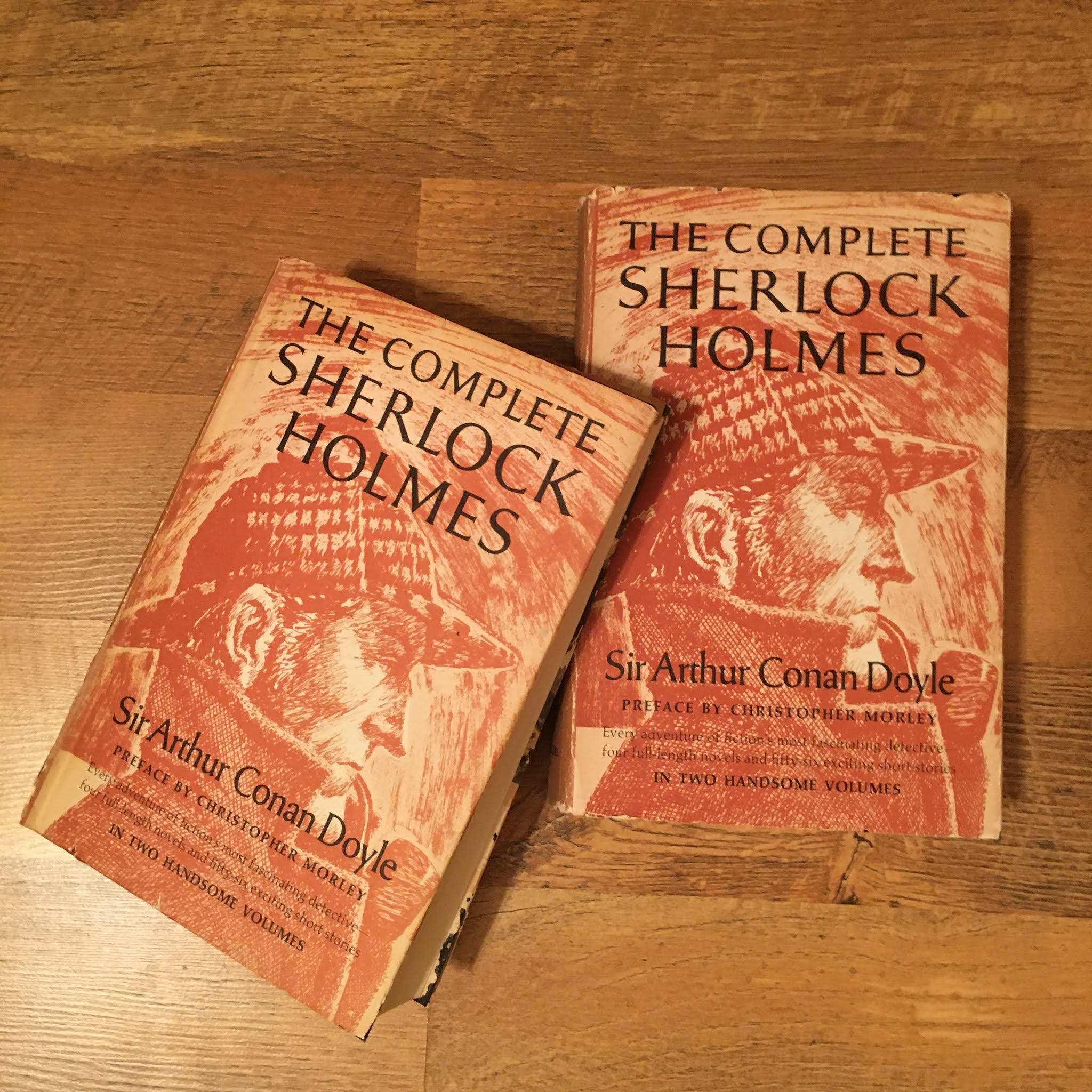
Well, at long last I have waded into the weird and wonderful world of Sherlock Holmes. Sherlock is one of those classic literary characters that I've always meant to read, but never got around to. We own The Complete Sherlock Holmes in "two handsome volumes" that Doubleday put out in the late 1920s. 
Because our Sherlock Holmes is all bound up in those two hefty editions, they sat on my shelf largely ignored for several years as classics I'd get around to someday. I didn't even know how many books Sir Arthur Conan Doyle had written about Sherlock or how they were compiled or anything until just this year. All I knew was that it was a lot and I didn't know where to begin. As it happens, right before our big move to North Carolina a few months ago, Cody and I snagged the BBC mini-series Sherlock on DVD from our Friends of the Library bookstore for a measly buck a season. After moving and getting settled in, we decided to start the show, and after watching the first episode, I decided it was time for my proper introduction to the OG Sherlock Holmes. 

So let me break down some of the quick facts for you: there were ultimately nine books Conan Doyle put out about the famous "consulting detective" Sherlock Holmes. Four novels, and fifty-six short stories which were originally published in magazines then later collected in five anthologies. The first (A Study in Scarlet) was published in 1887, and the final (The Case-Book of Sherlock Holmes) was published in 1927. Interestingly, Conan Doyle was ambivalent toward his popular creation. As the demand for Holmes stories grew, Conan Doyle actually wrote to his mother that he often thought of killing the character off and being done with him because "he takes my mind from better things." An idea which horrified his mother. In an attempt to scare off publishers, he raised his price level to what he thought was an unreasonable amount, but that didn't keep them away. He ended up becoming one of the best paid authors of his time. 

My "two handsome volumes" arrange the books of Sherlock Holmes chronologically according to the dates they were originally published individually and that's how I decided to tackle them. So in this post, I'll be talking about the first two novels: A Study in Scarlet and The Sign of Four. 

So this short novel was the world's first introduction to the now famous duo of Sherlock Holmes and Dr. Watson. Conan Doyle wrote it at the age of 27 in less than three weeks. 

The first part of the novel is written from the perspective of Dr. Watson as his diary. (Most of the subsequent stories about Holmes are written in this way—as Dr. Watson's reminiscences.) He recounts how he and Holmes came to meet and room together at 221B Baker Street in London, and then goes on to describe the first case he accompanied Holmes on involving a murdered man named Enoch Drebber. Shortly thereafter, Drebber's secretary Joseph Strangerson also turns up dead, and Holmes in his unorthodox and brilliant way figures the case out and apprehends the murderer. 

In the second part of the novel, we're abruptly taken back in time and across the ocean to the Salt Lake Valley in Utah in 1847 where a story unfolds about a man and little girl who are at the brink of death in the desert when they are rescued by a band of pioneer Mormons on the condition that they adopt the Mormon faith. 

Let me tell you, the transition between Part 1 and Part 2 of the novel was so abrupt and so unexpected that I spent a good bit of time wondering if this was actually two separate short stories and if we were ever going to figure out how Sherlock Holmes had solved the case in Part 1. As it turns out, Part 2 is the backstory of the two murdered men and their murderer, and it does all come together in the end. I was completely wrapped up in it, and just as impressed as Dr. Watson with Sherlock Holmes' uncanny ability to unravel the mystery. 

I have to add: Conan Doyle's unsparing and merciless depiction of Mormonism in this novel was a thing to behold. It took me by surprise, and I have to wonder, given Sherlock Holmes' universal popularity, if he has many Mormon enthusiasts and what their opinion of this first novel is. 

One other fun tidbit about A Study in Scarlet is that it was the first work of detective fiction to incorporate the magnifying glass as an investigative tool. 

The Sign of Four was Conan Doyle's second novel featuring Sherlock Holmes and his boon companion Dr. John Watson. It was commissioned in August 1889 by the American businessman Joseph Marshall Stoddart who was the managing editor of Lippincott's Monthly Magazine, and first published in the magazine in February 1890. 

This novel has a much more complex plot involving a stolen treasure, secret pacts among convicts and corrupt prison guards, poison darts, a one-legged man, and even a boat chase down the River Thames. It was quite a ride and I enjoyed every minute of it. 

We also get to meet Dr. Watson's future wife Mary Morstan in this novel, and we learn that Sherlock Holmes has a drug problem. It was a bit of a shock to open upon Holmes casually shooting up a solution of cocaine because he was bored by the recent lack of interesting cases with a disapproving Dr. Watson sitting by, annoyed. 

These first two novels were not particularly successful to start with, and it was the ensuing short stories that launched Sherlock's widespread popularity. I'm currently reading the Adventures of Sherlock Holmes and hope to also read the Memoirs of Sherlock Holmes to complete Volume 1 of The Complete Sherlock Holmes by the end of the year. I can't believe it's taken me this long in life to actually read some Sir Arthur Conan Doyle especially given my penchant for mystery stories as a kid. I thoroughly enjoyed his first two novels about Holmes and Watson. Conan Doyle's writing is sparse and to-the-point which makes for quick reading. His style reminds me a lot of Agatha Christie. It's easy to see how his influence has impacted the mystery writers that have followed him. So far the short stories are even more fun as they're easily read in one sitting, and it's no wonder they're so popular. I, for one, can now join the ranks of other Sherlock fans in recommending his strange cases to mystery lovers everywhere. 

Do you like a good mystery? Have you ever read any of Dr. John Watson's reminiscences about Sherlock Holmes? Do you prefer the novels or the short stories? 

Monday, June 21, 2021

Let's Bust a Recap : The Thirteenth Pearl

Last week in my recap of The Sweetness at the Bottom of the Pie, I mentioned that I cut my proverbial reading teeth on The Boxcar Children and Nancy Drew mysteries. When I was a kid, I couldn't get enough Nancy Drew and my grandmother would collect secondhand copies throughout the year. She had a standing agreement with the owner of our local used bookshop in which he called her any time Nancy Drews came in and she got first dibs before he put them out on the shelves. Whenever a birthday or Christmas came around, I got a new stack of Nancy Drews to read which I promptly devoured.

Now I have a niece who has started to read and guess what books she loves. Nancy Drew mysteries. Any time she comes to my house, she is immediately drawn to the shelf with all the faded yellow spines. When she accompanied me to our new home in NC, the first thing we unpacked were the Nancy Drews and she chose The Thirteenth Pearl which we began reading aloud together. 

She left before we could finish it, but I can't start a book and then just quit so I finished it by myself. 

The Thirteenth Pearl is the last of the original 56 Nancy Drew mystery stories published by Grosset & Dunlap. There have been many iterations since then and now there are literally hundreds of Nancy Drew books including the Nancy Drew and the Clue Crew collection which are the ones my niece has been reading on her own. The Thirteenth Pearl was published in 1979 under the familiar pseudonym Carolyn Keene but was actually written by Harriet Stratemeyer Adams. As the Nancy Drew books were first being published, there were a few different authors who wrote them, and it was written into their contracts that they would be paid $125 per book and required to give up all rights to the work and maintain confidentiality. In every book, Nancy Drew is an 18 year old high school graduate and amateur detective who solves crime with the help of her two best friends George and Bess and occasionally her hunky college boyfriend Ned. She lives with her widowed father and their housekeeper Hannah Gruen, and she drives around in a blue convertible. She often gets kidnapped or caught up in some kind of danger before she solves the case. 

In The Thirteenth Pearl, Nancy is trying to find a rare and valuable pearl that has been stolen which leads her all the way to Japan tracking an international ring of jewel thieves. The book takes an odd turn when Nancy finds herself in the midst of a creepy pearl-worshiping cult, but she, of course, solves the case and catches the bad guys. 

I was pleasantly surprised in reading this book how well-researched it was, and also by the positive depiction of Japanese people and culture. My grandfather served in WWII, and I grew up with a somewhat negative image of the Japanese. After my brother and sister-in-law lived in Japan, and now that I have a Japanese niece, I became a lot more sensitive about this issue and started intentionally adding Japanese literature to my collection. This book has aged surprisingly well given that it was written and published in the '70s, and I'm looking forward to sharing it with my niece one day. 

Nancy Drew has become a cultural icon and is cited as a formative influence by a number of high powered women including Supreme Court Justices and former First Ladies. This collection will always be special to me because of the gift of love they were from my grandmother, but rereading them as an adult is proving to be a rewarding experience in its own right. Definitely would recommend a Nancy Drew book for your daughter or niece or neighborhood kid or even you if you're looking for something quick to bust you out of a reading slump or to kickstart a reading life that's gone stale. 

What books sparked a love for reading in you?
~a 10 year old Hannah reading The Secret of the Old Clock~

Monday, June 14, 2021

Let's Bust a Recap : The Sweetness at the Bottom of the Pie

Well, we're halfway through June and I'm somehow just now recapping a book I read in the middle of March. So as you can see, things are going real well over here. 
The Sweetness at the Bottom of the Pie by Alan Bradley was published in 2009 after he won the Debut Dagger Award in 2007 for submitting the first chapter and a brief synopsis of the book. His win sparked a bidding war, he sold the publishing rights in three different countries, and then he spent the next several months developing that first chapter into a full-length novel which was published well after he was 70 years old. After the smashing success of The Sweetness at the Bottom of the Pie, he continued to write more Flavia de Luce mysteries turning it into a ten-book series over the next ten years. Amazing, right?

And guess what. It's my favorite book of 2021 so far. (Well, in all honesty, it's now tied for first with another book I read more recently, but that's neither here nor there. And you'll just have to stick around to find out what the other front-runner is.)

In The Sweetness at the Bottom of the Pie, we meet 11 year old Flavia de Luce, the youngest of three sisters who live at their country estate Buckshaw in the 1950s with their widowed father. When a red-headed stranger turns up dead in their cucumber patch and their father is hauled in as a suspect, Flavia decides to take matters into her own hands, hops on her trusty bicycle Gladys, and single-handedly solves the case. 

I loved everything about this "delightfully old-fashioned mystery" and about Flavia herself. An aspiring chemist with her own fully-equipped laboratory at Buckshaw, Flavia is whip-smart, laugh-out-loud funny, and a mischievous little prankster. Bradley's writing style has been described as reminiscent of the Golden Age of crime writing. As a reader who cut my teeth on The Boxcar Children and Nancy Drew, falling into Flavia's world was utterly charming and somehow nostalgic of what drew me to a love of reading in the first place. I ended up using The Sweetness at the Bottom of the Pie to check off the "book that reminds you of childhood" slot in The Unread Shelf's 2021 Unread Book Bingo

Ten out of ten, would recommend. Flavia de Luce is a riot, and I can't wait for my next visit with her.

What books made you love reading? Have you read any of the Flavia de Luce mysteries? 

Monday, December 3, 2018

Let's Bust a Recap : And Then There Were None

Y'all. This was the last book I finished in October

PSA: it's December. I've bought a grand total of like, one Christmas present, and I have six blog posts just waiting to be written. My tree is up and there are lights on it (thanks to my husband), but there's a gigantic Rubbermaid bin of ornaments and other decorations sitting open in the middle of my living room. Will my tree be decorated by Christmas Eve? Maybe. Will we still be talking about books I read in 2018 after 2019 has already started? Probably. Let's just keep our expectations nice and low and enjoy the holidays, deal?

Okay, so last year I read my first Agatha Christie and thoroughly enjoyed it. I decided to follow it up this year with her most popular work and the one that has personally been the most recommended to me, And Then There Were None. This, the most difficult of her books to write according to Christie, was published in the UK in 1939 and the US in 1940. More than 100 million copies have been sold, and, not only is it the world's best-selling mystery, it's also just one of the best-selling books of all time. Pretty impressive. 

In this book, ten strangers are randomly and somewhat mysteriously summoned to Soldier Island, an isolated rock off the Devon coast. Completely cut off from civilization with no host present to greet them, they are each charged with committing terrible crimes. 

And then they start dying, one by one. 

Who could the murderer be? Will any of them make it off Soldier Island alive? Will the police ever figure this out? Y'all. I thought Murder on the Orient Express had a masterful ending, but that was child's play compared to And Then There Were None. Christie managed to create the impossible murder mystery and then brought it home in the most incredible (and satisfying) way imaginable. 

I have very mixed emotions about this book. Not the actual book itself, but my reading of it. On the one hand, I'm so glad I read it. It is excellent. 10 out of 10 would recommend to a friend. On the other hand, I have absolutely peaked with Christie. It makes total sense to me that this is her most popular book, and I will call you a liar to your face if you tell me there is a better Christie mystery out there. 

So how do you follow that up? I still haven't landed at the level of fandom which would compel me to read every book she's ever written, but I do still own three more of her novels. I'm thinking maybe I'll take a break from Christie in 2019 and then put a Miss Marple on my 2020 book list. What are we thinking, friends? Are you fans of Agatha Christie? Should I just keep reading Christie mysteries every year for the rest of my life on earth? So many books, so little time! Give me all the advice.

Monday, November 13, 2017

Let's Bust a Recap : Murder on the Orient Express

Well, I have finally arrived in the world of Agatha Christie. This was my first of her many, many novels and it took a major motion picture coming out this month to finally kick my booty into gear. I'll be honest: Agatha Christie has never been a real high priority of mine. Despite her status as the best-selling novelist of all time and the fact that her works trail only the Bible and Shakespeare as the world's most widely published books, I have never at any point in my life been dying to read her. But what with the aforementioned movie coming out, Christie shot up to the top of my Life List and into the murder mystery pool I dove. 

Murder on the Orient Express was first published at the beginning of 1934 and features Christie's popular Belgian detective, Hercule Poirot. (Somebody please school me on the pronunciation of that name. To the best of my knowledge, it comes out sounding something like "air-kyul pwarrow"....am I close?) Our famous detective finds himself stuck on a train that has gone straight into a snowbank, but to make matters worse, one of the passengers turns up dead in his bed having been stabbed 12 times sometime in the middle of the night. The killer has to be on the train because of their unexpected stop in the snow. Can Hercule Poirot figure this out? 

Oh he can, y'all. Because apparently, he is the smartest, most clever detective you ever did see. 

What I liked most about this book was the way all the facts, evidence, and testimonies were laid out had me trying to solve the mystery right along with Poirot. I mean, I almost got out my own little notebook to start taking my own notes on the case, but I'm just not that dedicated. And I DID figure part of it out. But the conclusion was so intricate, masterful, and outrageous that it left me sitting with a stupefied grin on my face. Literally. I just sat in my rocker for a good 3 minutes grinning like an idiot and trying to decide how I felt about the ending. I also appreciated the humor in this novel as Christie had Poirot's cronies jumping to conclusions all over the place and getting more and more exasperated at the seeming impossibility of the case. 

If you're looking for cons, Murder on the Orient Express was not as unputdownable as I was expecting it to be. Every Christie fan talks about how engrossing her novels are, and I would not quite put this one in that category. If you are trying to solve it along with Hercule, the details start to get a little overwhelming as there are so many suspects. 

Overall though, I thoroughly enjoyed this one, and I look forward to reading more of Christie's work. Not all of it, mind you, but definitely more. I purchased Murder on the Orient Express in a box set of "The World's Favourite Agatha Christie" which also included And Then There Were None and The Murder of Roger Ackroyd. Both of those come highly recommended by friends of mine so I'm psyched to read them. I would also like to read one of her Miss Marple novels at some point. 

So let me have it: what are your favorite novels by Agatha Christie? What can I not miss? Have you read any of the Miss Marple mysteries? Which one(s) should I read? Bring it on. I can handle it. Did any of you see the movie over the weekend? No spoilers, please, but what did you think? I plan to see it this coming weekend, and I'll definitely let you know what I think.