Wednesday, August 21, 2024

A Word for Wednesday

 "You remember winning, don't you? A battle won, somewhere?"

"No," said the old man, deep under. "I don't remember anyone winning anywhere any time.
War's never a winning thing, Charlie. 
You just lose all the time, and the one who loses last asks for terms.
All I remember is a lot of losing and sadness and nothing good but the end of it.
The end of it, Charles, that was a winning all to itself, having nothing to do with guns.
But I don't suppose that's the kind of victory you boys mean for me to talk on."

~from Dandelion Wine by Ray Bradbury~

Monday, July 1, 2024

Let's Bust a Recap : The Man Who Was Thursday

So here's the thing: in my mind I've been a fan of G.K. Chesterton for a long time. I put him up there with Lewis and Tolkien and think that I love him. But the truth is: I've never actually read any G.K. Chesterton. I know, I know. It's one of those cases of I just didn't know where to start. Well, a few years ago, my sister Caroline was all excited about this new book she had just gotten by Sarah Clarkson called Book Girl. I haven't read it, but I was flipping through Caroline's copy shortly after she got it, mainly wanting to peruse all the different book lists. I found one contributor who listed several of my favorite books in her (his?) list of recommended reads and The Man Who Was Thursday was one of her favorites so I thought, "Aha! Here's the G.K. Chesterton book I should read!" and then immediately ordered a copy off amazon. (I also started collecting the Lord Peter Wimsey series by Dorothy Sayers because of this same book list, but I haven't started reading any of those yet.) Naturally The Man Who Was Thursday sat on my shelf the last several years unread, but the magic of the TBR Jar put it into my hands and I finally ended up reading it in May. 

And it was just okay. I don't know, you guys, it wasn't all that and a bag of chips for me. *shrugs* Maybe my timing was off or my expectations were out of line, but it didn't really do it for me. I mean, I enjoyed it for what it was. I thought it was funny. I thought the writing was good. But, I don't know, the ending was weird. I didn't really "get" it. The book has been called a metaphysical thriller, but I figured out the twists, and then the sharp allegorical left turn at the end left me scratching my head.

The Man Who Was Thursday subtitled "A Nightmare" by Gilbert Keith Chesterton was published in 1908. It's basically about a man called Gabriel Syme who has been recruited at Scotland Yard to be part of a mysterious anti-anarchist police corps. Through a series of events, he gets himself elected to the anarchist central council which is made up of seven men, each one a different day of the week. So, as is obvious by the book's title, Gabriel is elected to the Thursday position. The novel goes on to detail his efforts to stop the next anarchist plot of the council and his discoveries about the other six members. 

The novelist Kingsley Amis said of The Man Who Was Thursday: "Definition remains impossible: [it] is not quite a political bad dream, nor a metaphysical thriller, nor a cosmic joke in the form of a spy novel, but it has something of all three. What it has most of is a boy's adventure story." And maybe that's my issue with it. I can't pinpoint what it is. It's all very madcap and zany, and it was a good time. I just don't see myself ever re-reading it, and I'm not sure that I'll ever go out of my way to read anything else by Chesterton. 

What am I missing?

Monday, June 24, 2024

Let's Bust a Recap : Christ from Beginning to End

Christ from Beginning to End was Cody's and my first read-aloud for 2024. One of our dear friends sent it to me for my birthday a few years ago, and we decided it would be a good one to read together. We started mid-January and finished it the first week of May. Our loose goal was to read one chapter a week, and we pretty much stuck to it. 

Christ from Beginning to End: How the Full Story of Scripture Reveals the Full Glory of Christ, co-authored by Trent Hunter and Stephen Wellum, was published in 2018. Shortly after Cody and I started reading this, we learned that Trent is one of the pastors at our current pastor's previous church. Hunter's and Wellum's stated goal in writing this book is to help Christians better understand how every part of Scripture fits to reveal the glory of Jesus Christ. According to their acknowledgments, the book came from the two-fold conviction that the church must know and proclaim the whole counsel of God, and that books that discuss how the Bible is all about Christ are for the entire church—not just academics. 

The book is divided into two parts: Opening the Book and Reading the Story. Reading Part I felt a little like being in school. There was a lot of basic information that, for Cody and me, was not new. But it explained how each chapter in Part II would be structured—Looking Down (the close context), Looking Back (the continuing context), and Looking Ahead (the complete context). I'll be honest, those first four chapters were a bit dry, but Part II of the book is a completely different story. We couldn't make it through a single chapter without me getting choked up or outright crying. In Reading the Story, Hunter and Wellum take the reader through the entire story of the Bible, explaining how it all points to Christ. From beginning to end. *ba-dum ching* 

Part II is made up of eleven chapters starting with the Creation; moving through key characters in the Old Testament like Noah, Abraham, Moses, and David, showing how none of them were the answer to our sin problem; finally to Jesus revealed; then the Church; and ending with the New Creation. The story of the Bible is the story of our world, and it is truly the most beautiful story ever told. Wellum and Hunter did a fantastic job of showing how this story is cohesive and complete. Once I got into the meat of the book, I appreciated Part I a lot more because the structure of looking down, looking back, and looking ahead was vital, not only to understanding this particular book, but in understanding the Bible itself. Just starting out, Cody and I both noted how this would be an excellent book to hand a new believer or someone who had never read the Bible before and was feeling intimidated by it. But the further we got into the book, the more I saw the value for people who have read the Bible multiple times as well. I try to read through the whole Bible about every other year, and Christ from Beginning to End was a great companion book as I started the journey again this year. It's easy to view the Bible as more of a treasury of lots of stories than one cohesive book, and reading Christ from Beginning to End was a wonderful reminder to remember the big picture, remember what it is I'm holding in my hands each day. God's very Word to me, revealing His Son and the plan for my salvation. Every part of His Word points to His Son, points to my salvation. Wow. What a glorious story.

Christ from Beginning to End is a book I would highly recommend. It prompted a lot of great discussion between Cody and me, and it helped me to look at the beautiful story of Scripture with fresh eyes. So much of what we read in this book was being reinforced concurrently in my personal reading of the Bible and in sermons our pastor was preaching while we were working our way through it. It's always amazing to me when I can see so clearly how the Holy Spirit is teaching me something, and He was definitely teaching me while Cody and I read this book together. All in all, this is a great resource and a book I'm so glad Cody and I read together.

Monday, June 17, 2024

Let's Bust a Recap : The Hunting of the Last Dragon

Okay, so this was another acquisition from one of the Little Free Libraries in my brother's neighborhood out in Los Angeles. And much like with Riding Freedom, I brought this one home thinking it would be fun to read with my nephew. But here's a friendly PSA to all you adults out there who like to read books with the kids in your life: do yourself a favor and just check the target audience the book is intended for. The Hunting of the Last Dragon was published and marketed to the young adult crowd, and if I had even skimmed the first page, I probably wouldn't have tried to read this to my nephew in the Year of Our Lord 2024. 

But, as it happened, I sat down with my six year old reading buddy to start this book together and we encountered "corpses" and "half-devoured bodies" within the first chapter which made for an unexpected vocabulary lesson. Upon the completion of that first chapter, my nephew declared, "Auntie Hannah, I think this book is too scary for me." 

Bury me now.

I quickly agreed with him and said we didn't have to read any more of it to which he promptly responded, "But I want to read it." 

The kid has a dark side. It's one of the things I love about him.

We finally agreed that the best course of action to prevent nightmares was to have me read it by myself and then tell him about it. A decision strongly confirmed when a few chapters later there was an attempted rape. Suffice it to say: lesson learned.

But after that rocky start I really enjoyed this little novel. Set in medieval England in 1356, The Hunting of the Last Dragon is the brave tale of Jude of Doran and his companion Jing-wei and their quest to slay the last dragon as told to Brother Benedict at the Monastery of St. Edmund at Minstan. After Jude's entire family and village fall victim to the terrifying fire from the sky, Jude finds himself in the company of a young Chinese woman who has been caged as a freak show for a traveling circus. After a harrowing escape from the traveling fair, they end up on this journey to vanquish the dragon, and Jude's small world is widened by his friendship with Jing-wei. Award-winning Kiwi author Sherryl Jordan had this book published in 2002, and her device of having Jude tell his story to Brother Benedict with all Jude's comic asides played wonderfully for me. I was swept into the tale and rooting for Jude and Jing-wei to prevail and find a happily ever after. 

We are now solidly two for two on the books I procured in LA—both of them books I got with my kiddos in mind and didn't particularly expect to enjoy so much myself. The Hunting of the Last Dragon is a book I would read again and definitely recommend, but for the love of good dreams, NOT to the six year olds. I'll definitely be keeping an eye out for some of Sherryl Jordan's other books. 

Have you ever had a read-aloud fiasco?

Monday, June 10, 2024

Let's Bust a Recap : A Lineage of Grace

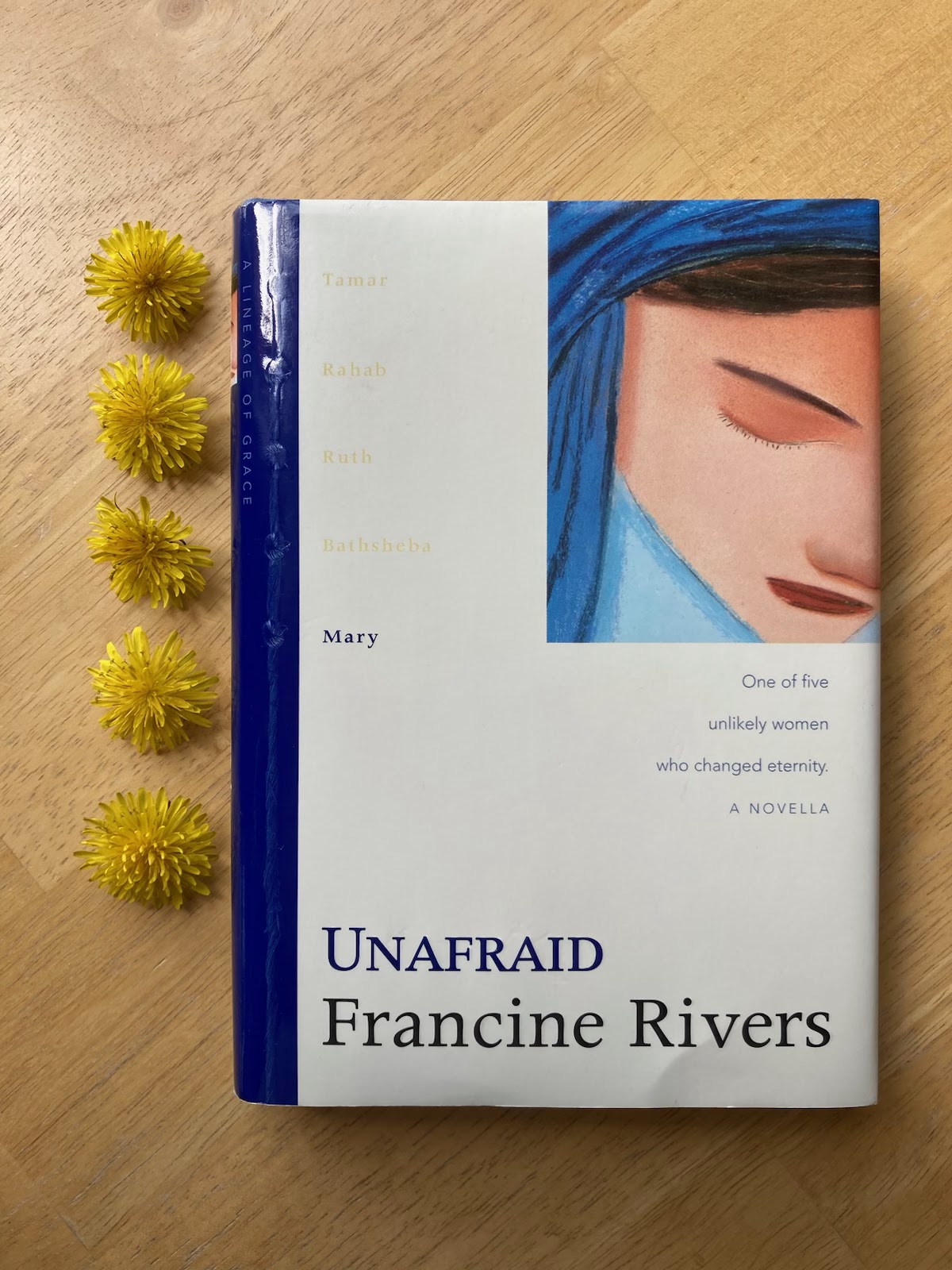
Hi there! Summer is finally upon us (still a little weird living in a place where there are actual seasons) and I am loving it. Is it summer where you live and what are your favorite summer activities? Do you even like summer? Maybe we should get on to the recap. When I started working through Teresa Whiting's DisGraced study, I decided it would be a great time to revisit Francine Rivers' Lineage of Grace series. The first three women Teresa covers in her study are Tamar, Rahab, and Bathsheba, all of whom are in the lineage of Christ. So as I was working my way through DisGraced, I also took time to read through these five novellas by one of my favorite authors

This first book in the series brings the story of Tamar to life and was first published in April of 2000. You can read Tamar's story in Genesis 38. She's also mentioned in Ruth, 1 Chronicles, and, of course, in the lineage of Jesus in Matthew. Tamar's story is one of the harder ones to read about in Scripture. It's what I would call a rated R narrative, and even though culturally we're so far removed from what was acceptable in Tamar's day, it's hard to wrap your head around seducing your father-in-law and then bearing his twin sons. 

What I like about Francine Rivers' attempt to bring these women to life is that she starts each book with a note encouraging the reader to check out the actual Biblical account—with references—and she keeps the fictionalization to a minimum. Obviously, we can't know any details about these women beyond what the Bible provides, but I think Rivers does a good job of towing the line and not creating too sensational of a backstory or additional characters. In the case of Tamar, the thing that really stopped me in my tracks was the fact that they were literally dragging Tamar out to burn her alive when she sent Judah the proof that he was the father. Sometimes, when I'm reading a very familiar Bible story, I don't stop to think about how these real people were really feeling. How terrifying for Tamar, probably a very young woman in her 20s if not still a teenager at this point, to literally be staring down death and not even sure that Judah would relent once he received his things from her. My heart can't help but go out to her in her desperation. What a story. 

The second woman named in the line of Jesus is Rahab. This installment of Rivers' series was published just five months after Tamar's in September of 2000. Rahab's story can be found in Joshua 2 and 6, and she's also commended in Hebrews and James for her great faith. 

Rahab's is one of the more famous Bible stories. She was the Canaanite prostitute who hid two Israelite spies and, as a result, was saved from the destruction of Jericho when the walls collapsed. The thing that intrigued me about Rivers' picture of Rahab's life is the idea that she was looking out for the spies. I never gave it much thought as a child, but as an adult I've often wondered how the spies ended up at the home of a prostitute. I honestly don't think they were there for her *ahem* professional services, but why were they there? The idea that she was looking out for them in the hope that she could be rescued from the destruction to come seems plausible. Another interesting notion that Rivers posits is that Rahab ends up marrying one of the spies. From my reading of Scripture, we don't know the identities of the men who went into Jericho so it's something to consider. 

Now Ruth is one of only two women in Scripture who has an entire book of the Bible named after her and dedicated to her story. Francine Rivers' novella about her life was published in February of 2001. 

What came alive for me for the first time when I read Rivers' Unshaken was the connection between Rahab, Boaz, and Ruth. Rahab, the Canaanite prostitute was Boaz's mother. Of course Boaz would have an extra measure of compassion for outsiders. In fact, could the reason Boaz was an older unmarried man in Israel possibly be connected to the fact that his mother was Rahab? Perhaps Israelite fathers weren't keen to make that unsavory association. It's all very compelling to think about. The question this little novella raised for me was whether Rahab was still alive when Boaz married Ruth. I imagine that if she was, she lived in Boaz's house. Did Rahab and Ruth have a relationship with one another? Obviously, Ruth and Naomi were very close, but was Ruth able to develop an intimate relationship with her second mother-in-law? One that would offer her untold encouragement and support living as a Moabite woman among the people of Israel? I wonder. 

The fourth book in this little series is called Unspoken and it details Bathsheba's life as imagined by Francine Rivers. It was originally published about six months after Ruth's volume in August of 2001. You can read about Bathsheba in 2 Samuel 11 and 12 and 1 Kings 1 and 2. She is also mentioned in 1 Chronicles 3 and you can get even more insight into her life by reading Psalm 51, the psalm David famously wrote after committing adultery with her.

I think of all the books in the Lineage of Grace, Rivers takes the most license with Bathsheba's story. She starts with Bathsheba as an eight year old girl with a massive crush on the young giant-killer David. I don't think it's too big of a stretch to imagine that young Bathsheba idolized David—he was the biggest celebrity of his time—but to posit that her obsession with him continued even to the day of her wedding and beyond is maybe a bit much to believe. While I don't agree with the line of thinking that David raped Bathsheba, I also don't agree with Rivers that Bathsheba knew that David was watching her bathe and brazenly displayed herself to him. 

When I first read this novella as a young adult, I was intrigued by the idea that because of Bathsheba's situation, her friends and family may have shunned her, never speaking her name again. This thought becomes even more fascinating when you actually read the lineage of Jesus and see her referred to only as the wife of Uriah. 

Reading it this time around, I was more interested in Bathsheba's familial relations—her father being one of David's mighty men along with her husband Uriah, and her grandfather being one of David's trusted advisors. I even did a little fact-checking on this in Scripture and it all seems to track. I never made the connection that Ahithophel was Bathsheba's grandfather, and it's intriguing to think about how his granddaughter's relationship with David may have been a factor in his betrayal of David

Anyway, Bathsheba's story is pretty wild and I think Francine Rivers definitely gives her reader plenty to think about with the way she presents it. 

Ahhh, Mary. Sweet virgin mother of Jesus. Certainly the most famous woman in Scripture and arguably the most famous woman to ever live. This last novella in the series was published in October of 2001 meaning all five books in the series were published in the span of a year and a half. It's hard to pick out just a few passages about Mary to refer you to her story in the Bible when her life was so intimately intertwined with the life of Jesus, but some key references include Luke 1-2, Matthew 1-2, John 2Mark 6, Matthew 12, John 19, and Acts 1

I think of the five novellas in the Lineage of Grace, I read Mary's with the most caution. As I mentioned at the beginning of this post, Francine Rivers herself is quick to point the reader back to the Biblical accounts of these women's lives and it's a reminder that bears repeating. But having said that, I think Unafraid may offer the reader the most to think about and discuss. While we can't possibly know for sure if Rivers is right in her depiction of Mary's understanding of Jesus' purpose or her impatience in wanting him to assert himself as the promised Messiah, everything she writes in this little novella is extremely plausible, and Mary's thoughts and attitudes are natural human responses to the situation she found herself in. There's so little we know of Jesus' growing-up years on earth, and Rivers does a fantastic job of sparking the reader's imagination in thinking about what those years may have been like. I especially liked her depiction of Joseph's relationship to the Christ-child and how she imagined Jesus with his brothers and sisters. I hope we get to know more about Jesus' earthly life when we get to Heaven. It's something I wonder about often. 

All in all, I would recommend the Lineage of Grace series with the exhortation to read them as companions to the original Biblical accounts, keeping in mind that these are just ideas of what it may have been like for these women. I'm a fan of anything that makes me think more deeply about Scripture and I love when something can make Scripture come alive for me. I think this series by Francine Rivers does a great job of both. But ultimately, it's the Word of God that will never pass away and I can't emphasize enough how important it is to keep His Word central when we're consuming Bible-based media and entertainment. 

Is there a particular story from the Bible you wish you could have witnessed? Or a person from the Bible you wish you could have lunch with and pick his or her brain? 

Monday, June 3, 2024

Let's Bust a Recap : Lie Until It's True

Jessie Weaver's sophomore novel is out! I knew after reading Live Your Best Lie last year that I'd definitely read anything else Jessie had to offer so I went ahead and preordered Lie Until It's True and then read it immediately after it showed up at my door last month. 

Lie Until It's True zooms in on one of the secondary characters from Weaver's debut novel Live Your Best Lie, but this young adult murder mystery is not a sequel. In this one, we learn that the last three years of sixteen year old Amanda Pruitt's life have been consumed with a murder trial and she is more than ready to move on from it. She ends up spending the summer with her aunt who works at a historic (haunted?) hotel in Colorado. Her childhood best friend's mother has been accused of murder in what seems like an open-and-shut case, but Amanda is hoping to spark a deeper investigation into what happened using her popular true crime TikTok account. But when someone else turns up dead, Amanda finds herself a prime suspect and right in the middle of another horrible murder investigation. 

First of all, if you're going to read Jessie's books, I'd say read them in order. As I mentioned, Lie Until It's True isn't a sequel but it does take place after the events in Live Your Best Lie and if you read it first, you will be able to eliminate a suspect from her first book. 

Secondly, I'd say I liked Jessie's debut better than Lie Until It's True, but this new release is highly readable and the murder mystery aspect kept me guessing again. I liked the romance element in this one, the ghost story component was fun, and the entire novel had a very summer camp vibe that I liked a lot. I thought wrapping the book up with an Ask Me Anything section was a clever way to tie up some lingering questions given the way social media features in the book. But my main complaint from Live Your Best Lie—the rude language and casual misuse of God's name—seemed even more pervasive in Lie Until It's True, and I got tired of it quickly. 

All things considered though, I'm still a fan and definitely looking forward to what Jessie puts out next. While I, once again, might hesitate to hand this book to actual teenagers without caveat-ing, I would conditionally recommend it. And because of the contrasting haunted hotel/summer camp themes, Lie Until It's True is a good read year-round for all you mood readers out there. 

Who's your favorite murder mystery author?

Tuesday, May 28, 2024

Let's Bust a Recap : Roald Dahl

Well, I've gotten a couple more Dahls under my belt so it's time for a recap, but unfortunately, these are the first two of Roald's books that have fallen slightly flat for me. I read both of these aloud with my nephew, and they were funny but they're just not on the same level with the rest of his work. (At least his work that I've read so far.)

In Dahl's 1970 Fantastic Mr Fox, our titular character—Mr Fox—spends his days cleverly stealing from three loathsome farmers—Boggis, Bunce, and Bean—to feed his wife and four children. Eventually, the farmers get fed up with this and determine to kill Mr Fox, but he still manages to outsmart them by burrowing his way to their goods and continuing to steal from them to help his own family and all the other underground creatures to survive. The book ends with the three farmers sitting outside Mr Fox's hole still, waiting for him to surface so they can blow him to smithereens. 

In Dahl's 1990 Esio Trot—the last book to be published in his lifetime—our lonely protagonist Mr Hoppy comes up with a devious plot to win the heart and hand of his downstairs neighbor Mrs Silver, a widow he's been smitten with for years but has been too shy to ever do more than speak to her from his upstairs balcony. Mrs Silver's entire life centers around her small pet tortoise Alfie but she's concerned that he's not growing so Mr Hoppy convinces her to speak to Alfie in tortoise language three times a day to help him grow faster. (Tortoise language is just regular English backwards; hence "Esio Trot" is an anadrome of "tortoise".) She, of course, gives this a try but what Mr Hoppy actually does is steal Alfie and replace him with a slightly larger tortoise...which he continues to do until "Alfie" can no longer fit through the door of his little tortoise house and Mrs Silver realizes the "magic words" worked and is so delighted with Mr Hoppy that they get married. 

I mean, I think we can all agree that we're not out here reading Roald Dahl to learn any great moral lessons but can you see how these two might be a bit problematic? They're both silly and clever and certainly not meant to be taken seriously, but is it okay to steal from people if they're fat and ugly and stupid? Sure, it's in a fox's nature to hunt, but in Fantastic Mr Fox we've anthropomorphised him so it begs the question. And is it ever okay to trick a woman into marrying you by means of stealing her beloved pet? A living animal, I might add? Granted, Dahl assures us that the real Alfie ends up living happily ever after with a little girl called Roberta Squibb, but does Mr Hoppy ever come clean with Mrs Silver? And can a relationship based on deception possibly turn out all right? These books can provide a great jumping off point for some important conversations but for sheer entertainment value's sake? They miss the mark. 

So no, these wouldn't be the first Roald Dahl books I'd recommend, but if you're ready to have a low-pressure philosophical conversation with your child after a few laughs, these might be just the ticket. 

As for my journey through Dahl's work, I'm now over halfway through my lovely box set of his books and have six left to go. What should come next?