Monday, July 13, 2020

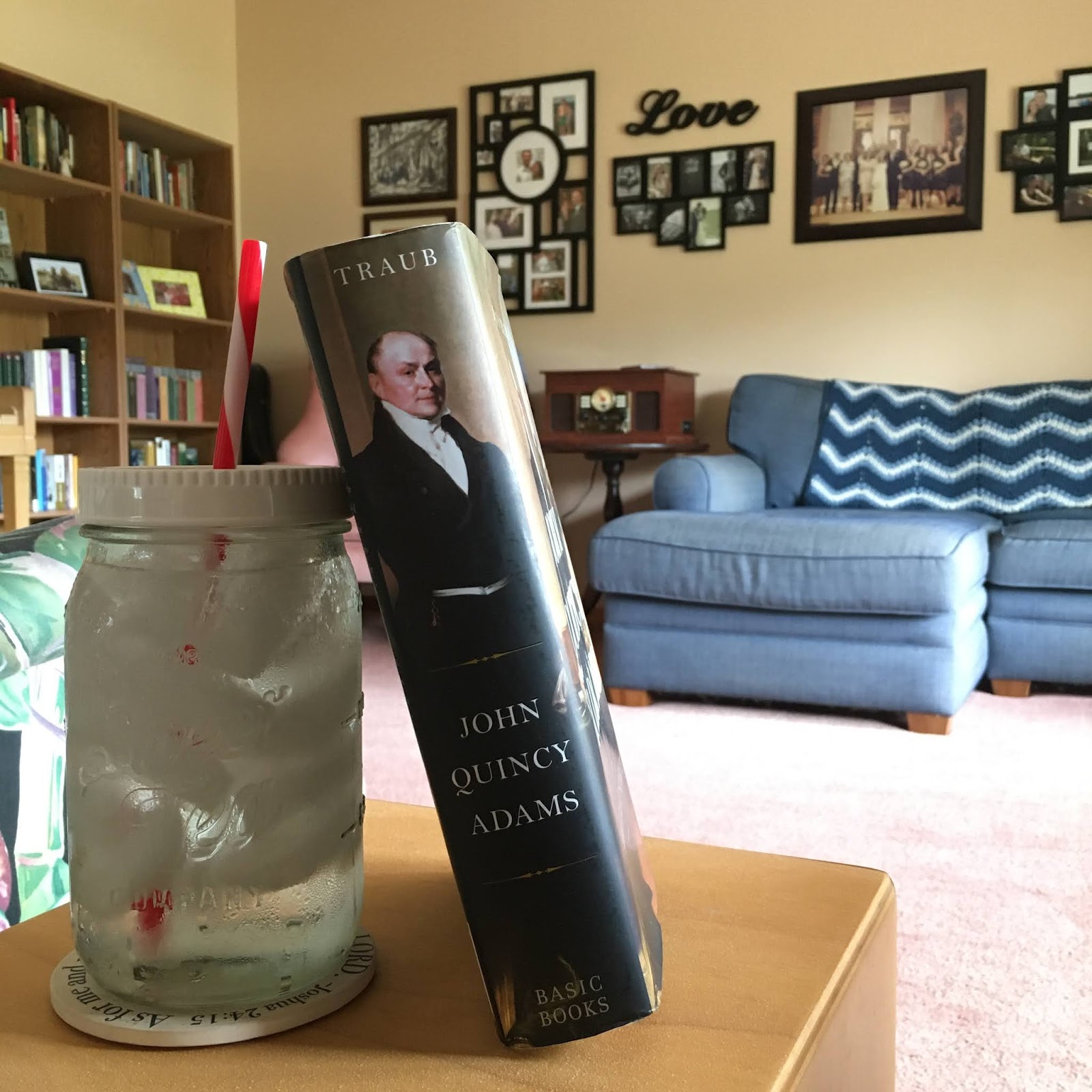
Let's Bust a Recap : John Quincy Adams

It. Is. Finished. It took me way too long to read this biography, and I have two more (both about Andrew Jackson) on my list for 2020. I technically began reading this one the first week of February, but given the pandemic and stay home orders and general madness of the world, I largely ignored JQA until June. I think between the time I started in February and June 1st, I only managed eight or nine chapters. I finally buckled down last month and finished up this 540-page biography last week. I still have a stack of books waiting to be recapped siting in my reading nook, but I have to be pretty quick on the turnaround with my presidential biographies before everything I learned falls back out of my head. 

That being said, let's get after it.

John Quincy Adams: Militant Spirit by James Traub was published in March of 2016. I originally intended to read a biography of our nation's sixth president written by Harlow Giles Unger, but after reading his laughably biased biography of Monroe last year, I got rid of the Unger biography of John Quincy Adams and picked up this one by Traub instead. Which led me to make a new rule in my quest to read through the presidents: no back-to-back biographies by the same author. I think reading about the same period of history and men who worked together from different authorial perspectives will be more beneficial than just getting one person's take. 

Traub certainly put together an excellent biography. He managed to be comprehensive without bogging it down with too much detail. He interwove Adams' political and personal life seamlessly throughout the entire biography which I really appreciated. (Other biographers sometimes have the tendency to focus wholly on the political component forgetting altogether the human side of their subjects.) His biography was readable and insightful, and if you're looking for a good bio of John Quincy Adams, I would definitely recommend this one.

However, John Quincy Adams himself is not fun. He was a consummate politician, and, even more so than Madison, politics were his entire life. He was the first (and only) president to serve in the House of Representatives after his presidency (instead of having the good grace to retire) and he literally died in the House during the congressional session of 1848.

Adams served as the U.S. ambassador to the Netherlands, Portugal, Prussia, Russia, and Britain under Washington's, his father's, and Madison's administrations. He took on the role of U.S. Senator (from Massachusetts) during Jefferson's administration, and he worked tirelessly as Secretary of State under Monroe's administration. There is absolutely no logical reason he should have been elected president over Andrew Jackson, and he spent his one term in office largely ineffectual because of his stubborn political idealism. Harrison Gray Otis, a contemporary of John Quincy Adams, characterized the entire line of Adams men as "a peculiar species of our race exhibiting a combination of talent & good moral character, with passions and prejudices calculated to defeat their own objects & embarrass their friends." I found this to be a penetrating insight and discerning assessment of John Quincy Adams in particular.

After his presidency, during his time in the House of Representatives, Adams took up the cause of petitions, particularly anti-slavery petitions, and bullheadedly fought the gag rule imposed by the Democrat-ruled House. While being vehemently opposed to slavery morally, Adams did not think Congress had the right to legislate slavery, and he was not an abolitionist though he did believe slavery would eventually be eradicated. I actually found this period of his life—specifically his political life—the most interesting to read about.

On a personal level, I never would have been friends with John Quincy Adams. He was a terrible husband, and he and Louisa had a pretty miserable marriage. He held his sons to impossible standards, and was only outlived by his youngest son Charles, the only son he ever cultivated a good relationship with. Solid friendships were conspicuously absent from this biography. He is the first president I've read about who seemed to have no outstanding friendships or correspondence with other colleagues. While those who worked closest with him did seem to grudgingly respect him, he really didn't get along with anyone for long. 

One of my favorite bits of this whole biography was actually the account of Louisa's solo trip from Russia to France during Napoleon's bloody Hundred Days War. Louisa Catherine Adams was, honestly, a somewhat pathetic character (I mean, you can hardly blame her given who she was married to and the fact that she had to endure miscarriages, very difficult pregnancies, and the deaths of all her children excepting Charles), but she really bucked up and took to this six week adventure with gusto. It really makes you wonder what her life would have been like if she had married a warm, attentive partner rather than the austere and somewhat neglectful John Quincy Adams.

All in all, good biography; less-than-stellar subject. If you're on a similar quest to read through the American presidents, this would be a great biography for you when you get to John Quincy Adams. If you're not particularly interested in JQA, I can't really blame you. He was a total killjoy. 

Next up: Andrew Jackson. 

Have you read any good biographies or non-fiction lately? Do you have any specific lofty reading goals? I think my two biggest ones are: 1) reading a biography of every U.S. president, and 2) reading the complete works of Shakespeare. How are your 2020 reading goals coming along?

Thursday, July 2, 2020

Let's Bust a Recap : Maisie Dobbs

Well, so much for catching up on the blog during May...or June, apparently. It's now July and I still have a stack of books sitting in my favorite reading nook waiting to be chronicled here. As I shared over in my Instagram stories the other day: 
You're all living in the same world I am so I don't have to explain that any further. 

Anyway, in an effort to revive this little corner of cyberspace, today we'll be talking about Maisie Dobbs. This debut novel from author Jacqueline Winspear was published in 2003 and is the first book in the Maisie Dobbs series which is now 15 books strong. I typically avoid new book series like the plague, usually opting for stand alone novels. Most of my all time favorite books in the world are actually book series (Anne of Green Gables, The Chronicles of Narnia, Christy Miller—I'm lookin' at you) so this aversion to series shouldn't make any sense, but there's this part of me that feels like there isn't any more room in my life for book series and it's too much of a commitment to get involved with a new series when there are so many other books on my shelves. Silly maybe, but there it is. I'm not sure why we've wandered so far down this rabbit hole of my literary psyche, but suffice it to say: I did not go looking for a new series to start. In my many trips to The Book Shelter (my favorite local secondhand bookshop) this slim volume kept catching my eye. I must have picked it up and read the back on no less than five previous visits, and I finally concluded that this book was meant to be added to my collection (along with four of the Flavia de Luce mysteries—another series!) and brought it home earlier this year with absolutely no intention of reading it any time soon. 

However, my mother came over looking for a book to borrow for one of her work trips, and naturally I had to show her my latest haul (keep in mind, this was back in January; that's how far behind we are) and she decided to snag Maisie Dobbs knowing that if she waited for me to read it first, she may never get to read it. Well, not only did she read it, she had my dad read it. And they both hyped it so well that I decided I needed to read it immediately. So the first week of April saw me throwing my 2020 book list to the wind and getting lost in the post-WWI era of Maisie Dobbs and tagging along on her first official case as an independent private investigator. What seems to be an open-and-shut case of infidelity ends up leading Maisie into a much deeper, darker web of secrets that force her to confront the horrors of her own experiences during the Great War.

I loved this book. The pacing was not too fast and not too slow. The historical points were well researched and informed the story without being tedious or inserted awkwardly. I connected emotionally with the story, and it definitely left me wanting to read more of the series although this debut stands easily on its own. I thought the author did an excellent job setting up the case in the first third of the book, taking us back in time and developing Maisie's backstory in the middle of the novel, and then naturally pulling us back to the present for the resolution (and when I say "present" I mean 1929, the year in which the case is set).

I have absolutely zero reservations in recommending Maisie Dobbs. My mom and dad and I all enjoyed it, and this is a book (and probably series) I would have devoured as a teenager. I'm looking forward to adding more Maisie Dobbs to my library and tagging along on more of her cases in the future.

Have you read any of the Maisie Dobbs books? Do you prefer book series or stand alone novels? What are some of your favorite series to get lost in? 

Tuesday, May 19, 2020

Wednesday, May 13, 2020

Let's Bust a Recap : Tuck Everlasting

Tuck Everlasting was the last book I read in March, and I immediately fell in love with this sweet little story. Originally published in 1975, this children's novel by Natalie Babbitt has gone on to win a whole passel of awards, has been adapted twice for the screen and also into a musical.

Telling the story of eleven year old Winnie Foster and her accidental discovery of the Tuck family who are blessed with doomed to eternal life after drinking from a secret spring, this short novel explores the concept of immortality and how it might not be all it's cracked up to be. It has sold over five million copies and has been called a classic of modern children's literature.

And I'm here for it. I was delighted with the writing and Babbitt's talent for creating winsome imagery. I was compelled by the story and didn't want to put the book down. And I was a little sad that I somehow missed this book during my childhood. This is definitely a story I will revisit and I think it would have been an easy favorite with me when I was younger. It's a new favorite now, for sure.

My only exposure to this story prior to finally reading it was seeing the 2002 Disney film adaptation starring Alexis Bledel as Winnie when it came out. At that time, the movie didn't really make an impression on me and certainly didn't pique my interest in reading the book. I kindof forgot about it and moved on with my life. Enter #bookstagram. When I joined that little community at the end of 2018, I discovered that there are definitely some big-time fans of this children's novel so I tucked that away in my memory bank and when I happened across this old copy at The Book Shelter, I brought it home and stuck it on the shelf. After reading it, I decided to revisit the movie (Disney+ for the win!) and I can now fully appreciate it for the travesty it is. Having only just read this book for the first time, it has so fully wormed its way into my heart that watching the movie was an affront to my literary senses. I will admit that I'm a bit of book snob when it comes to film adaptations, but this one was a particularly poor representation of such a wonderful book.

All said, I highly recommend reading Tuck Everlasting and just as highly discourage watching the movie. I hope you will be just as delighted with it as I was and that you fall in love with Winnie Foster and the Tuck family forever.

Have you ever read Tuck Everlasting or seen the 2002 movie? What is one of your all-time favorite children's novels?

Monday, May 4, 2020

Let's Bust a Recap : Lies Women Believe

Hello! Yes, the blog lives. I ended up taking a big break in April. You'd think with all the corona craziness and staying at home and social distancing I'd have more time than ever to get some posts together for the blog. And you would be right. But instead of focusing on that, I did a lot of reading in April without worrying about immediately writing recaps about each of the books I finished. Whitney at The Unread Shelf hosted an online BINGO game to motivate people to check off some of their unread books during quarantine, and I am all about that. As you know (or maybe you don't), my whole goal in starting this blog and creating yearly book lists for myself was to tackle my own unread shelves instead of constantly reverting to my favorite re-reads. All this to say, I read six books in April. None of them were from my 2020 book list. But they were all books I own that I hadn't read before so we'll chalk that up as a win and now my goal for May is to recap them all here on the blog. So let's get to it.

Lies Women Believe was on my list to read this year, and I actually finished it March 20th. According to my Goodreads account, I started this book near the beginning of January. And it's true, I intentionally took this book at a pretty slow pace. Most of it I ended up reading with a friend and we met to discuss it once a week which was a really beneficial approach. 

Lies Women Believe by Nancy Leigh DeMoss was originally released in 2001, but an updated and expanded version of the book was published in 2018. I have the original version while my friend has the newer version so in meeting and discussing the book, we got the best of both worlds though I appreciated my original copy more than her newer edition (for reasons I'll expound on later). DeMoss states at the beginning of the book that her goal is to expose areas of deception most commonly believed by Christian women and offer tools to help the reader counter and overcome these lies and walk in God's freedom and grace. With chapters on lies about God, sin, circumstances, and priorities (to name a few), DeMoss ambitiously covers a lot of ground. 

And I don't think she does the best job with it. She doesn't do a bad job, but I did not think she developed each topic in a meaningful way. At best, she presents a commonly believed lie, provides a few anecdotal stories about said lie, gives some thoughts about why it's a lie, then moves on to her next topic. While DeMoss and I fundamentally line up in our beliefs and I ultimately didn't disagree with any of her points, some of her writing came across as cavalier and I could see how a casual reader would be very turned off to her approach. Don't get me wrong, I believe God's Word is offensive to sinners (of which I am chief) and there's not really any sugarcoating it. But in just scratching the surface of so many lies (each of which could easily be developed into a book of its own), DeMoss doesn't always come across the page as loving or helpful. 

Having said that, I do believe DeMoss writes with loving intention and that Lies Women Believe has the potential to be a very helpful book. If you're reading to be offended, you will be. But if you are genuinely reading to seek truth, you will find it. In the second chapter of the book, DeMoss says, "it's not enough to ask, 'Do I believe this lie?' Each of us must also ask, 'Do I live as though I believe this lie?'" And that was the best way to introduce her book. For me, as someone who has grown up with my faith from the time I was born, it is very easy to identify a lie on paper and reject it. To examine my life and find areas where I'm living as if I believe a lie is a very different (and challenging) matter. 

In my opinion, the greatest value of this book are the pages DeMoss includes at the end of each chapter entitled "Countering Lies With the Truth" and "Making It Personal". In any given chapter, DeMoss covers three to six lies within the stated topic. For example, in her chapter "Lies Women Believe About God", DeMoss deals with the lies "God is not really good", "God doesn't love me", and "God is not really enough" among others. At the end of the chapter, DeMoss re-states the lies she tackled countering them with the truth including several Scripture references to back it up. If she had just released a pamphlet with these pages and the book recommendations included in the back of Lies Women Believe, that would be just as valuable a resource as her entire book. After the "Countering Lies With Truth" page, she also includes pages in the 2001 edition that she entitles "Making It Personal". This is why I liked my copy of the book better than the updated and expanded version that my friend had. These pages aren't included in the newer version, and the very best part of my reading experience of this book was going through these pages, reading the suggested Scripture aloud, thinking deeper about changes I need to make in my life, and reading (and praying) the heartfelt prayers that Nancy Leigh DeMoss includes at the end. 

All in all, I'm glad I read this book and it was helpful to me. Meeting and discussing it with my friend deepened my experience with it, and I would definitely recommend reading it with someone if you decide to pick this up. Things that hit me a certain way didn't have the same impact on my friend and vice versa so discussing the book with someone else opened my eyes to the value of passages that I didn't think were necessarily that great at the time I read them. Obviously, the best and most helpful source of truth will always be the Word of God so my top recommendation will always be to start there. 

Have you read Lies Women Believe? Or have you ever read a book that was well-intentioned but maybe didn't deliver on those intentions? Let me know in the comments. And be on the lookout for more recaps in May including ones for Tuck Everlasting, Charlotte's Web, and Their Eyes Were Watching God!

Wednesday, April 1, 2020

A Word for Wednesday

"'Snow in April is abominable,' said Anne. 
'Like a slap in the face when you expected a kiss.'"

~from Anne of Ingleside by L.M. Montgomery~

Monday, March 23, 2020

Let's Bust a Recap : A Little Princess

A Little Princess by Frances Hodgson Burnett was first published as a book in 1905. However, it is actually an expansion of a serialized short story that was originally titled "Sara Crewe: or, What Happened at Miss Minchin's" published in St. Nicholas Magazine in 1887 and 1888. After Burnett put together a play from "Sara Crewe", her publishers requested that she expand the story into a novel including "the things and people that had been left out before". 

And aren't we all glad she did? This children's novel has been among educators' favorites since its publication, and it is widely considered to be one of the best children's novels of all time (along with Burnett's other novel The Secret Garden which I haven't gotten to yet). I can't even believe it's taken me this long in life to get to it, especially considering that I've owned and watched the two most popular movie adaptations of it many times. 

And speaking of the movies, naturally I watched them (back-to-back) after finishing the book so I'll be discussing a few key spoilers in this post. Don't say I didn't warn you.

In A Little Princess, we meet clever little Sara Crewe who is being brought to Miss Minchin's boarding school in London by her widowed father. She and her papa are the best of mates, but it was widely believed that the weather in India (where they lived) wasn't good for little girls hence her relocation to the highly recommended school. Her father instructs Miss Minchin to spare no expense in little Sara's upbringing and education and assures her that his pockets are deep enough to cover any and every little thing Sara desires. You'd expect her to be a hopelessly spoiled brat, but Sara is actually the sweetest, kindest, most generous little girl and she befriends and helps all the little outcasts in Miss Minchin's school. 

Through a series of unfortunate events, we learn (at Sara's extravagant birthday party no less) that her father has died and left her completely penniless at which point Miss Minchin takes away all her things, banishes her to the attic, and works her almost to death. Despite her tragic downfall and awful mistreatment, Sara is determined to behave like a little princess and (mostly) manages to keep her sweetness. 

In the end, Crewe's friend and business partner is able to find Sara and restore her wealth to her tenfold. He adopts her, Miss Minchin gets her comeuppance, and it's truly a happily ever after. 

Now let's talk about how the movies held up compared to my actual reading of A Little Princess starting with the 1939 version starring Shirley Temple as Sara. Let me tell you: I am a fan of Shirley Temple. I own no less than 14 of her films on DVD and some of my sweetest memories in life were curling up with my Grandmother to watch Shirley Temple sing and dance. It's hard not to adore her in just about any role, but Sara Crewe she is not. The Little Princess never was one of my favorites from her, and now having read the novel, it's even less so. While they did keep the basic idea of the book (riches to rags back to riches), they drastically changed the ending having Sara be reunited with her father who was wounded in the Boer War, and they added an entire subplot of a teacher's romance with the school's riding master which Sara helps along in any way she can. (And this movie came out during that wonderful time in film where there was often a wacky dream sequence which usually came out of nowhere. I can pinpoint this scene in the film being the reason it's never been my favorite Shirley Temple movie.) The whole thing just comes off pretty ridiculous and honestly, Shirley Temple was a little too old for this role at the time of this film. Kindof a bummer, but there you have it.

In the 1995 version starring Liesel Matthews as Sara, they stuck to this same plot of having Captain Crewe going to war (only it was WWI in this case) and being reunited with Sara in the end in the most dramatic way possible. While I don't appreciate the liberties taken in either movies' cases, there is still something so lovable about the 1995 version. For one thing, it's gorgeous. Beautifully filmed, beautiful score, just an absolute pleasure to watch. For another thing, this movie honed in on Sara's relationships with the other little girls and did a fantastic job of it which was a big part of the story. Her friendships with Becky, Lottie, and Ermengarde were spot on in this adaptation, and Liesel Matthews was a much better Sara Crewe than Shirley Temple was though neither girl fit my mental picture of what Sara Crewe ought to look like. 

All in all, this book is a can't miss. It was so sweet, and I loved it. While I did come into it with some preconceived ideas based on my history with the movies, the book still came out much better and I would highly recommend it. If I don't get to The Secret Garden this year, it will definitely go on next year's list. As for the movies, as much as it pains me to say it, skip Shirley Temple but for the love of cinema: watch the '95 version. 

Have you read anything by Frances Hodgson Burnett? If you've read A Little Princess and The Secret Garden, which did you like better? And have you seen the movie adaptations? (Feel free to throw Shirley Temple some love in the comments. My personal favorites are Rebecca of Sunnybrook Farm and Little Miss Broadway, and I feel a Shirley Temple marathon coming on soon with all this quarantining and "social distancing".)